Context in Math: Do Students See It?

I am frequently asked (yesterday, for example) whether students have changed during my time working with developmental students.  People often assume that I will say ‘yes, their math skills are even worse’ … I don’t say this, because I do not believe it’s true.  Certainly, there have been changes — areas of ignorance and zones of bad ideas have shifted, but not in a fundamental way and not in a significantly increasing way.  My answer is this:

Students have changed, especially in the past 10 years, in terms of their academic and social skills.  More effort is needed — in all of my classes, not just the lowest — on these soft skills.

Among these soft skills is an awareness of surroundings and knowledge of context.  Last week, I noticed a comment over at the Chronicle’s page (http://chronicle.com/article/So-Many-Hands-to-Hold-in-the/134454/?cid=cc&utm_source=cc&utm_medium=en):

I have a grandson who at 22 cannot literally read a real map!  He cannot navigate himself to and from a doctor’s appointment or an auto parts store without the directions capability of his smart phone.  Technology is a wonderful thing; however, it does have a down side.  In the grandson’s instance, he does not pick out reference points as to where to turn or to retrace his steps, ie, being aware of his surroundings.

If you look for this comment, be sure to load older comments (this one is from about Sept 19).  Context is critical in mathematics, like most other academic areas; one can not know context if one is unaware of surroundings. 

In math classes, this means that students are even more likely to apply a strategy or concept when it does not apply (context) … students are more resistant to analysis of special cases (surroundings).  The student magic and silver bullet used to be ‘know all the formulas’; now, the silver bullet is ‘know the one formula. 

For those of us who like to teach math ‘in context’, I wonder if the nature of our students makes this approach less desirable.  If students have trouble identifying context accurately, and we teach from context, they may not see the intended context. [In many cases, I think students see our ‘context’ as just a longer word problem that is more interesting.]

For all of us, I wonder if our students see their mathematical surroundings in the intended manner.  Learning is constrained by perception; incomplete perception can not lead to quality learning of mathematics.

 Join Dev Math Revival on Facebook:

Answer Standards Fight Mathematics

“Negative exponents are not allowed in answers.”

My intermediate algebra class has not had negative exponents in the material so far.  However, here is what most students remember:

I can not have negatives, so write the reciprocal.  No exceptions.

Given the ‘answer desperation’ of most students, any ‘rule’ about the answer gets added emphasis in learning.  As teachers, many of us try to make it easy for students … so we add our emphasis.  The result is that our standards (often sensible but arbitrary) fight mathematical knowledge.  Students focus on the form of the answer and our rules about that, and have less understanding of the mathematics involved in the situation.

In the case of negative exponents, the rationale for ‘no negative exponents’ is marginal at best.  True, in some cases, positive exponents are simpler; however, for the majority of situations, negative exponents are simpler — they often avoid the need to write a fraction.  The evolution of exponential notation and meaning is based partially on the idea that negative exponents are a simpler way to show division … and fractional exponents are a simpler way to show roots.

For my class, the previous emphasis on ‘no negative exponents’ distracts them from understanding simple division problems.  We do more polynomial arithmetic than is really needed, but these division problems are just dividing a binomial or trinomial by a monomial.  The student answer desperation and the negative exponent prejudice combine to distract them from the basic ideas of division.

A related issue came up in my beginning algebra classes … students wondered if they should finish a fraction problem by changing it to a mixed number.  The context was solving a linear equation with one variable; the form of the answer is a trivial matter compared to the mathematics.  Overall, one of the most common questions I ever hear is “how do we need to write that answer”.  Sometimes, this deals with algebraic concepts and the question is valuable; many times the question is a distraction.  I often tell students that I don’t care what form they give an answer as long as it clearly communicates a correct result.

Perhaps we should take a step back from all of our simplistic statements about ‘form of the answer’.  Many of them are conveniences for grading work, nothing more.

 Join Dev Math Revival on Facebook:

A Recipe for Success (part of a faculty toolkit)

Earlier this month, I posted an item about a success toolkit for faculty (https://www.devmathrevival.net/?p=1266).  Most faculty know that building student success is not a ‘one and done’ type of effort — feedback, suggestions, and problem solving are needed.  Today, I want to share an update of a tool I like quite a bit — a “Recipe for Success”.

The idea for the Recipe for Success is that students — especially in developmental math courses — do not think enough about HOW they are approaching the course, that they often do not employ meta-cognitive skills.  Meta-cognition is a very complex zone to work in, and getting students started can be a challenge.  For years, I was not sure how to structure this component of success in a math classroom.

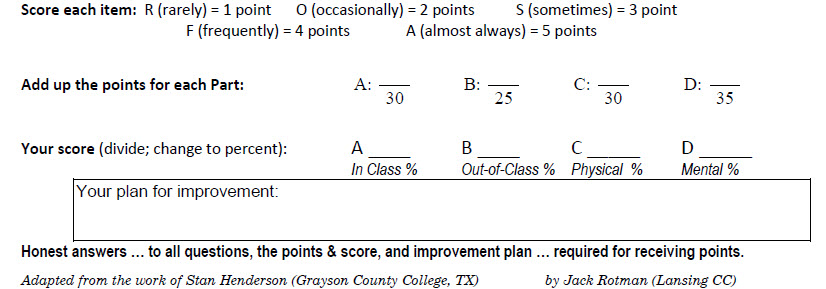
Last year, the faculty at Grayson County College (TX) shared a document called ‘Recipe for Success’ — originally developed by Stanley Henderson, who was kind enough to share it with me.  After using it and revisions, the start of the form looks like this:


The form has 4 areas like, with 5 to 7 questions within each.  After checking off a “ROSFA” rating for each, the student does the most important parts — a summary and a plan for improvement.  The bottom looks like this:


I assign points for completing this activity, which I normally schedule about the fourth week of the semester (enough time to have a pattern of working on the course).  Besides judging whether students were honest in answering the questions, I write some brief feedback on most of them (usually circling a couple of questions to think about).

If you want to take a look at the entire document, here is a link (PDF format): Recipe For Success in Math (Rotman Sept2012)

This type of activity can be a critical step in the process of building student success.  The form itself does not cause an improvement — it’s students thinking about learning, and instructor comments, that make the difference. 

 Join Dev Math Revival on Facebook:

Khan, Comfort, and the Doom of Mathematics

Perhaps you already knew this:

If students perceive instruction as clear, the result will be reinforcing existing knowledge (often not so good knowledge).

I recently ran into a reference to a fascinating item posted by Derek Muller, specifically about videos like the Khan academy; Dr Muller’s specific interest is science education (physics in particular), and you might find the presentation interesting http://www.youtube.com/watch?v=eVtCO84MDj8 (it’s just 8 minutes long).

In mathematics, even more than physics, students come to our classrooms with large amounts of prior experience with the material.  Of course, much of their existing knowledge is either incomplete or just plain wrong (whether they place into developmental math classes or not).  A ‘clear’ presentation means that the existing knowledge was not disturbed in any significant way.  Clear presentations make students even more confident in the validity of the knowledge they possess.  This is not learning.  Reinforcing wrong information is the doom of mathematics.

In Dr Muller’s study, two types of presentations were done.  The first were the ‘clear’ ones; students felt good about watching, but the result was absolutely no improvement in their learning.  The second type were ‘confusing’ ones, where the presentation deliberately stated common misunderstandings and explored them.  Students did not like watching these;  however, the result was significantly improved learning.

We see this in our classrooms.  This past Friday, a young man from my beginning algebra class came in to see me … he had left class in the middle, in a distracting way to other students.  Turns out that he left because he could not stand the confusion.  In talking to him, he believes he can do the algebra but he is getting very confused by the discussion in class about “why do that” and “here is another way to look at it”.  In fact, this student has a very low functioning level about algebra.  If he does not go through some confusion, his mathematical literacy will remain unchanged; that is to say … he won’t have any meaningful mathematical literacy.

Khan Academy videos are popular; I understand … I have watched some myself.  I consider them to be very clear and essentially useless for learning mathematics.  If a person already has good knowledge, they will not need them; if a person lacks some knowledge, they will not perceive what they lack from watching a video.  [Just like witness research in criminal justice, students perception is controlled by their understanding.]

The attraction of modules and NCAT-style redesign is often the clarity and focus.  Students do not generally see anything that might confuse them; the environment is artificially constrained to avoid as many confusing elements (inputs) as possible.  To the extent that students in these programs are ‘comfortable’ and the instruction ‘clear’, that is the extent to which existing knowledge is reinforced.  Learning can not happen if we primarily reinforce existing knowledge; confusion is an essential element in a learning environment.  [I sometimes tell my students that instead of being called a ‘teacher’ they should call me ‘confusion control expert’.]

I suspect some readers are thinking that “He has this wrong … I have data that shows that students do really learn.”  It’s true that I don’t have proof; I don’t even have my own research (though I would love to see some good cognitive research on these issues).  What I do know is that student performance on exams — especially procedural items — is a very poor measure of mathematical knowledge.  I suggest that you interview some average students that you think know their mathematics based on exam performance; have them explain why they did what they did … and have them explain the errors in another person’s work.  Based on what I have heard from students, I think that you will find that only the best students can show mathematical knowledge in an interview at a level equal to their exam performance; average students will struggle with the interview about their mathematics.

How do we avoid the doom of mathematics?  How do we prevent our classes from becoming reinforcers of existing knowledge?  I think we need to create environments for learning where every student faces some confusion on a regular basis … not overwhelming confusion, and not trivial confusion, but meaningful confusion about important mathematics.   Do we need an LCD to do that?  Must we move terms in an equation before we divide by the coefficient?  Is that distrubuting, or is that subtraction?   Confusion is where students bump into the areas of knowledge that need their attention.

Our students have a strong tendency to drive through our courses as fast as possible, without really dealing with mathematics.  They believe the myth that the experts always understand, that we are never confused.  We need to be comfortable in showing confusion to our students and model appropriate behavior to resolve it.  The appropriate response to confusion is figuring out where we went wrong … not running away for a comfortable explanation.  Confusion may call for some meta-cognitive efforts, or we may simply need to polish one particular mathematical idea.

Confusion is the fertile soil of learning.  Avoiding confusion creates a sterile environment without growth.  Comfort is fine, and we all need comfort; however, comfort never learned anything. 

 Join Dev Math Revival on Facebook:

WordPress Themes