MichMATYC session on Reform in Michigan (October 6, 2012)

I’m using this post to share the presentation slides for the session “Reform, not Redesign, in Developmental and Gateway Math Courses” at the 2012 MichMATYC conference (Monroe County Community College) held on October 6, 2012.

Presentation: Reform not Redesign in Developmental and Gateway Math Courses


Summary and Comparison of the Pathways, New Life, and Mathways

Three emerging models of developmental mathematics — AMATYC New Life, Carnegie Pathways, and Dana Center Mathways — have enough similarities that people can mistake one for another.  The basic genetic codes of these models does look very similar.  I’d like to provide some comments of comparison in order to highlight the differences; most of these differences are operational or matters of implementation.  You might want to read this Summary:  Summary of Three Emerging Models for Developmental Mathematics

One difference between the models is that the Pathways are always targeted towards specific groups of students — namely, students who only need an introductory statistics course (Statway) or only need a quantitative reasoning course (Quantway).  The New Life model can be implemented this way, which is what my own college is doing; however, the New Life model describes a curriculum that can completely replace a traditional developmental mathematics program.  Although still under development, the Dana Center Mathways is likely to be flexible in the same ways as the New Life model with some differences within the design.

All three models incorporate student success design factors.  The Pathways materials have both imbedded and supplemental work on issues such as productive struggle, deliberate practice, productive persistence, and growth mind-set.  The New Life model, because it is a professional framework, does not prescribe how these factors are incorporated in the local implementation; some instructional materials for the New Life model embed the design and others are strictly supplemental.  In the case of the Dana Center Mathways, the model includes a required student success course as a co-requisite; the details are still being developed.

Placement is handled differently in the models.  The Pathways (statway & quantway) are two-semester packages; the design assumes that all students begin in the first semester and continue into the second semester.  The New Life model could be implemented this way; however, the basic design suggests a normal process where some students could begin at the second-semester level without taking the first semester.  The preliminary descriptions of the Dana Center Mathways suggests that they will also provide flexibility concerning where students begin.

None of the models assume a change in the actual placement tests at this time.  In all three cases, the first course uses ‘placement into beginning algebra’ as the benchmark; local colleges adapt this guideline to their environment.  Since all three models focus on concepts of mathematical literacy, they collectively suggest that our placement tests need to have a measure of basic quantitative reasoning at a pre-college level.

The largest difference in implementation is in the domain of ‘institutional committment’.  The Pathways model presumes (and requires at this time) that the institution will sign a multi-year agreement to develop, implement, and participate in the activities of a shared network; individual faculty can not ‘join’ statway or quantway.  [However, the instructional materials will be publicly available later this month for open-use as version 1.0 (first classroom version) under a license like Creative Commons.]  The New Life model allows for individual faculty to pursue incremental changes at their institution, as well as allowing for institutions to make a committment for a larger change.  My current interpretation of the Dana Center Mathways model is that they will seek some level of institutional committment to a change, though the change might not be total reform of the curriculum.

Mathematically, the models differ in how they address the old intermediate algebra course. The Pathways model does not address this course in any way, since the student populations are selected to avoid intermediate algebra — the Pathways include mathematical literacy and the ‘terminal’ math course only.  The New Life model provides a replacement course (currently called “Transitions”) that can be used instead of intermediate algebra; the outcomes for Transitions include a fair amount of the topics of intermediate algebra — the approach is more balanced between symbolic and numeric work, and the content is not limited by tradition (exponential change is consider a basic skill in Transitions).  Although still being developed, I anticipate that the Dana Center Mathways model will also provide a replacement for intermediate algebra; this will provide the profession with two strong alternatives to the old ‘non-functional’ intermediate algebra.  [‘non-functional’ has two meanings — does not work well, and does not integrate function work]

I have been fortunate to have (1) led the New Life project, (2) been deeply involved with Pathways, and (3) involved with Dana Center Mathways [with the hope of doing more].  My statements above do not represent an official narrative from the 3 sources; rather, this is my professional evaluation offering a comparison.  To the extent that I have information or knowledge, I would be glad to answer questions about how the 3 models are similar or different.

 Join Dev Math Revival on Facebook:

Math – Applications for Living XVI: The Evils of Line Charts

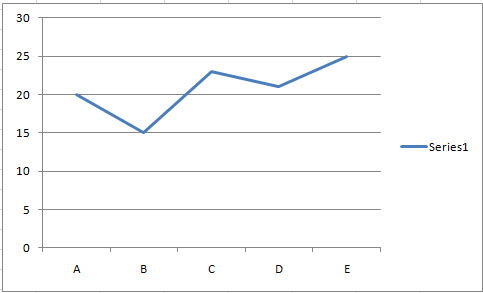
In our Math – Applications for Living class, we just finished our first chapter on statistics, which included some of the standard graphical displays (frequency charts, bar graphs,  and line charts) as well as scatter diagrams for bivariate data.  Based on observing students working with line charts, I commented to the class that line charts have a risk — human perception may suggest a much stronger pattern than is really present in the data.

Here is an arbitrary example of a line chart (pseudo-random data):

 Join Dev Math Revival on Facebook:


The same data presented in a bar graph looks like this:


A quick search on research related to this yielded a study done by Jeff Zacks and Barbara Taversky at Stanford (1999); see      http://dcl.wustl.edu/pubs/ZacksMemCog99.pdf.  Briefly, their study found that bars tended to processed discretely while lines tended to be processed as a pattern.  My examples above are not ideal examples … the correlation is fairly high, perhaps higher than the bar graphs suggest. 

It seems that scatter diagrams have some of the same risk as line charts, in the sense that my students want to visually connect the dots as in a line chart.  We are working on identifying patterns correctly in bivariate data, though my expectations are not high.  Human perception might have a strong desire to establish a pattern, even when some data needs to be excluded.


Accelerated Math Classes … A Temporary and Good Thing

One of the current trends in community colleges is to offer ‘accelerated math classes’, specifically an approach where students take two classes in one semester.  Sometimes the two classes are sequential (each about half a semester), other times they are integrated.  My own college is doing this for two ‘combos’ — pre-algebra paired with beginning algebra, and beginning algebra paired with intermediate algebra.  Is this a good solution?  For what portion of developmental math students?

To review … accelerated classes are intended to address the ‘exponential attrition’ that seems to occur almost universally over a sequence of math classes.  If a student has 3 math classes, there are two transition points — these transition points tend to have their own ‘pass rate’; the sequence survival rate is proportional to the 5th power of a pass rate, not the 3rd power.  The thought is that the transition rates are much higher if two classes are within one semester, or if a student perceives two classes as being one.  Data from sites doing this approach seems to support the hypotheses — a higher proportion of students complete both courses in one semester than complete them in two semesters.  Some people see modularization as a variation of accelerated learning; there are similarities … however, ‘accelerated’ refers to the same content at a faster rate, while modules tend to work with subsets and less content overall for a given student.

As a practice, I think accelerated learning is a good thing for some students.  Having more students pass a second course is a positive outcome; a typical gain would be going from 30% passing two courses in two semesters … to having 50% pass in one semester.  Our own ‘combo’ classes do not have a long enough history to determine what will be a sustainable level.  However, given the good results, some people suggest that either most or all students be placed into accelerated classes.  I am not supportive of that level of expansion.

One reason I am not supportive is that the traditional developmental courses have a limited life expectancy:  within 5 to 10 years, it is very likely that the majority of developmental mathematics will be based on the emerging models (AMATYC New Life, Carnegie Pathways,  Dana Center Mathways).  These emerging models provide either targeted solutions for a sequence OR a total replacement, which will shorten the sequence for some or all students.  The accelerated learning models will be far less necessary when we improve the basic design of our programs — including gateway college math courses.

Other reasons exist, as well, for questioning the generalization of the accelerated models.  A large portion of community college students have a limit to the class workload; in many cases, an accelerated model requires students to take 8 credits of mathematics in one semester … some students have a lower limit, and some must take a non-math class.  For those students, and all students, we should work to get them placed as far into the mathematics sequence as is reasonable.  Other students have a cognitive limit, including those with disabilities but also including a large number of ‘normal’ students; these are the students who need extra support and often spend extra time for a class.  We need applied research to help us identify the characteristics of students who can succeed in accelerated learning.  I suspect that there are other types of students who are not well suited to the methodologies of accelerated learning, beyond the ones listed above.

We also have a philosophical issue here:  Accelerated learning creates a message that “here is a necessary evil, let’s get it over with as quickly as possible”.  Given the traditional math curriculum, this is an accurate message.  However, we can do better.  Professionally, we are called to create mathematics programs that include sound mathematics and meet the needs of our students.  Like some other methodologies (emporium, modules, etc), accelerated learning reinforces the out-of-date design and inappropriate content.

We should first fix our curriculum, with a goal of directly solving the attrition problem by creating shorter sequences in the first place.  One developmental math course can meet the needs of many students; two developmental math courses can meet the needs of the vast majority of students.  Once we have established a new curriculum, we can look for accelerated learning again to see if there is still a need. 

 Join Dev Math Revival on Facebook:

WordPress Themes