Why We NEED Stand-Alone Remedial Courses

Extremes are seldom a good thing.  At one extreme, we had 4 or more developmental math courses at many institutions.  In the future, we may end up with zero dev math courses — as people drink the ‘co-requisite cool-aid’.  Moderation is usually a better thing than extremes. We need to consider the diverse reasons why remedial math courses make sense.

Let’s begin with a conjecture … that it is feasible to use co-requisite remediation for students beginning any college math course.  Each of the 3 major types of introductory math courses would have the needed remediation (pre-calculus, statistics, quantitative reasoning), with each of these remediation needs being different from the others.  In some implementations, the co-requisite remediation is built on the entire content of the old dev math course; however, students typically do not need to pass the remedial component — if the college course is passed, the remedial portion is either automatically passed or does not count.

This conjecture follows a common theme in the policy world — ‘stand-alone developmental courses are a barrier to student success’.  We have some evidence that the research data does not support this conclusion — the article recently cited here, written by Peter Bahr, as well as the CUNY “ASAP” program (I’ll post about that research in the near future).  The ‘data’ used for the stand-alone statement is demographic — students who place into a dev math course (especially multiple levels below college) are far less likely to complete a college math course.

Let’s pretend that the research in favor of dev math courses is mistaken, and that the true situation is better estimated by those attacking stand-alone courses.  What are the overall consequences of ‘no more dev math courses’?

In community college programs, students are faced with quantitative issues in a variety of courses outside of mathematics.  Here is a realistic scenario:

  • In a biology course, a student needs to understand exponential functions and perhaps basic ideas of logarithms.
  • In a nursing course, a student needs to apply dimensional analysis to convert units and determine dosage.
  • In an economics class, a student needs to really understand slopes and rate of change (at least in a linear way).
  • In a chemistry class, a student needs to apply equation concepts in new ways.

If we no longer have stand-alone developmental math courses, there are basic consequences:

  1. ALL courses in client disciplines will also need to do remediation (unless they require a college-level math course).
  2. Courses in client disciplines that do require a college math course will need to have that course listed as a prerequisite — even if the math needed is at the developmental level — OR such client discipline courses will also need to do remediation.
  3. Courses in client disciplines will always need to do remediation if they require a college math course that does not happen to include all of the background needed.

We might face similar consequences within mathematics, though those seem minor to me.  The consequences are trivial within STEM programs, but that is small consolation to the majority of our students (and colleagues).  The mis-match situation (#3) occurs with stand-alone courses, but will be more widespread without them.

Getting rid of stand-alone dev math courses is extremely short-sighted.  The premise is that all of a student’s needs in developmental mathematics relate to the college math course they will take.  If a student’s program is well served by statistics, does this  mean that all courses in the program are well served by a statistics course?

Even if co-requisite remediation produces sustainable high levels of success, the methodology fails to support our student needs — ‘solving’ one problem while creating several others.  Eliminating stand-alone developmental math courses is not a solution at all … eliminating stand-alone courses puts our students at risk AND harms our colleagues in partner disciplines.  I would also predict that co-requisite remediation will disproportionately ill-serve those who most need our help — students of color and students from lower “SES” (the low-power students).

The root-problem is not stand-alone courses — the root problem is that we have a too-long sequence of antiquated dev math courses.  We have a model for solving this problem in the New Life Project, with two modern courses: Mathematical Literacy, and Algebraic Literacy.  Both courses modernize the curriculum so that it serves mathematics as well as our client disciplines, with a structure that allows most students to have one (at most) pre-college course.

The co-requisite movement states that our responsibility ends with the college math course.  Our relationships with other disciplines is based on a larger responsibility; our work on student success factors within our courses is based on a larger responsibility.  Declaring that “the results are in” and “co-requisite remediation WORKS” … amounts to defining a problem out of existence while ignoring the problem itself.

Nobody needs co-requisite remediation; nobody needs 4 or 5 developmental math courses.  Our students need an efficient modern system for meeting their quantitative needs in college, regardless of their prior level of success.

 
Join Dev Math Revival on Facebook:


The Case for Remediation

Today, I am at a state-wide conference on developmental education (“MDEC”), where two presenters have addressed the question “is remediation a failure?”.  As you likely know, much of the recent conversation about developmental mathematics is based on a conclusion that the existing system is a failure.  The ‘failure’ or ‘success’ conclusion depends primarily on who is asking — not on the actual data itself.

The “failure” conclusion is presented by a set of change agents (CCA, CCRC, JFF); if you don’t know those acronyms, it’s worth your time to learn them (Complete College America; Community College Research Center; Jobs For the Future).  These conclusions are almost always based on a specific standard:

Of the students placed into developmental mathematics, how many of them take and pass a college-level math course.

In other words, the ‘failure’ conclusion is based on reducing the process of developmental mathematics down to a narrow and binary variable.  One of today’s presenters pointed out that the ‘failure’ conclusion for developmental math is actually a initial-college-course issue — most initial college courses have high failure rates and reduced retention to the next level.

The ‘success’ conclusion is reached by some researchers who employ a more sophisticated analysis.  A particular example of this is Peter Bahr, who has published several studies.  One of these is “Revisiting the Efficacy of Postsecondary Remediation”, which you can see at http://muse.jhu.edu/journals/review_of_higher_education/v033/33.2.bahr.html#b17.

My findings indicate that, with just two systematic exceptions, skill-deficient students who attain college-level English and math skill experience the various academic outcomes at rates that are very similar to those of college-prepared students who attain college-level competency in English and math. Thus, the results of this study demonstrate that postsecondary remediation is highly efficacious with respect to ameliorating both moderate and severe skill deficiencies, and both single and dual skill deficiencies, for those skill-deficient students who proceed successfully through the remedial sequence.  [discussion section of article]

In other words, students who arrive at college needing developmental mathematics achieve similar academic outcomes in completion, compared to those who arrived college-ready.  There is, of course, the problem of getting students through a sequence of developmental courses … and the problems of antiquated content.  Fixing those problems would further improve the results of remediation.

One of the issues we discuss in statistics is “know the author” … who wrote the study, and what was their motivation?  The authors who conclude ‘failure’ (CCA, CCRC, JFF) are either direct change agents or designed to support change; in addition, these authors have seldom included any depth in their analysis of developmental mathematics.  Compare this to the Bahr article cited; Bahr is an academic (sociologist) looking for patterns in data relative to larger issues of theory (equity, access, etc); Bahr did extensive analysis of the curriculum in ‘developmental math’ within the study, prior to producing any conclusions.

Who are you going to believe?

Some of us live in places where our answer does not matter … for now, because other people in power roles have decided who they are going to believe.  We have to trust that the current storms of change will eventually subside and a more reasoned approach can be applied.

In mathematics, we have our own reasons for modernizing the curriculum; sometimes, we can make progress on this goal at the same time as the ‘directed reforms’.  Some of us may have to delay that work, until the current storm fades.

Our work is important; remediation has value.  Look for opportunities to make changes based on professional standards and decisions.

I’ll look for other research with sound designs to share.  If you are aware of any, let me know!


Join Dev Math Revival on Facebook:


Implementing Better Math Courses, Part II: Helping All Students

The traditional developmental math curriculum generally fails the mission to help students succeed in college mathematics; this failure is due to both exponential attrition (too many courses) and to an obsolete curriculum.  In this post, I will describe a specific implementation plan that addresses these problems for ALL students.  #NewLifeMath

I call this implementation “medium” because it goes beyond the low results of pathways models.  The next level of implementation involves eliminating all courses prior to the beginning algebra level … and replacing beginning algebra with Math Literacy for College Students.

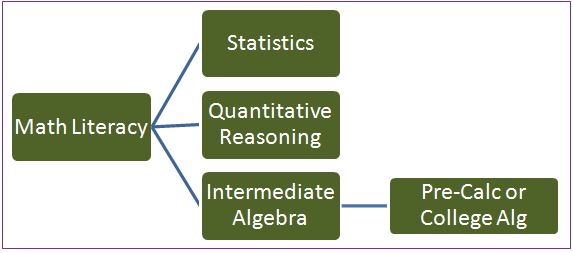
Here is an image of this implementation:
ImplementationMap MEDIUM March2016


This implementation means that the majority of students can have a maximum of one pre-college math course (developmental level), since most students do not need to take a pre-calculus course.  The Math Lit course was designed to serve the needs of all students — STEM and not-STEM; even though many of the initial uses of Math Lit were in pathways implementations, the course is much more powerful than that limited usage.

Doing this medium implementation results in significant benefits to students.  In order to make this work, the institution needs to address interface issues — both prior to Math Lit and after Math Lit.

Math Lit has a limited set of prerequisite knowledge that enables more students to succeed, compared to a beginning algebra course.  However, this set is not trivial.  Institutions doing a medium implementation will need to address remediation ‘prior’ to Math Lit for 20% to 40% of the population in the course.  One methodology to meet this need is to offer boot-camps prior to the semester, or during the first week.  The other method (which my institution is starting this fall) is to embed the remediation within the Math Lit course; in our case, we are creating a second version of Math Lit for 6 credits (with remediation) to run parallel to our 4-credit Math Lit course.

After Math Lit in this model, there is an interface with intermediate algebra.  At some institutions, this will work just fine … because the intermediate algebra course includes sufficient review of basic algebra.  In other institutions, some adjustments in intermediate algebra are needed.  My own institution is playing this safe for now … after Math Lit, students can take a ‘fast track’ algebra course that covers both beginning and intermediate algebra.  I don’t expect our structure to be long-standing, for a variety of reasons (most importantly, that we are likely to reach for the next level of implementation where intermediate algebra is replaced by algebraic literacy).

I suspect a common response to this implementation model is something like “this will not provide enough algebra skills for STEM”.  I would point out two factors that might help deal with this apparent problem:

  1. Taking beginning algebra prior to intermediate algebra is currently associated with lower pass rates (controlling for ACT Math score).  [See https://www.devmathrevival.net/?p=2412]
  2. The basic issue for STEM students is not skills — it is reasoning.  [See AMATYC Beyond Crossroads http://beyondcrossroads.matyc.org/   and the MAA CRAFTY work http://www.maa.org/programs/faculty-and-departments/curriculum-department-guidelines-recommendations/crafty ]

This medium implementation model is conceptually similar to the Dana Center New Mathways Project, where they follow up their adaptation of Math Lit (“FMR”) with their STEM path courses.  Like them, we have confidence based on professional work over a period of decades that this implementation model will succeed.

In a pathways model, only those students who are going to take statistics or quantitative reasoning get the benefits of a modern math course.  In the medium implementation, this set of benefits is provided to ALL students.  In addition, the medium implementation eliminates the penalties of having more than 2 developmental math courses in the curriculum, by dropping all courses prior to Math Lit.  The result is that the majority of students will have 1 (or zero) developmental math course, with improved preparation as well.

 Join Dev Math Revival on Facebook:

National Math Summit — resources, handouts, …

The National Math Summit 2016 was held in mid-March, with over 250 people attending.  We had a very productive 2-day event.

Now, you can access much of the information shared during the “NMS” (national math summit).  Resources and handouts have been posted to a drop-box.

The drop box is https://www.dropbox.com/sh/c3p3lizhfqjjic5/AAARt_ynsNIoeAvuZVOzPn5xa?dl=0

You can share this link, and download the materials from the drop box.  If you have questions about a particular item, contact the primary author.

  Join Dev Math Revival on Facebook:

WordPress Themes