Plus Four — The Role of Statistics in Mathematics Education

We’ve all been reading and hearing about this … statistics is critical in modern society (in a ‘world of uncertainty’, as some people say).  Some argue that all students should take an introductory statistics course in college, while others argue that some statistics be included in a general education course.  One of the latest blog writings on this is from Kevin Carey (see http://chronicle.com/blogs/brainstorm/everyone-should-learn-statistics/46353)

There are fundamental differences between statistics and ‘other areas’ of mathematics.  [I put ‘other areas’ in quotes because I question an equivalence between statistics and mathematics as scientific endeavors.]  In most ways, statistics is a laboratory science based on logic used to support or refute claims in an argument.  Some specialties in mathematics are much like this, though those specialties do not normally show up in community college mathematics programs. 

What is unsettling about an emphasis on statistics as a ‘better math requirement’ is that statistics supports methodologies based on getting better results … not just on properties of measurement.  Ever heard of “plus 4 confidence intervals”?  The ‘plus 4’ method is used for creating proportion confidence intervals; see http://www.math.metrostate.edu/mike/Course/Fa2006/ConfidenceIntervals.pdf for some background.  Essentially, an arbitrary adjustment is made to the sample size (n+4) and to the success outcome (p+2); this adjustment provides confidence intervals that are judged to be more appropriate.  As you can see, the ‘plus four’ procedure results in a success outcome closer to 50% for use in the confidence interval; there is no scientific basis given for doing this at all … we could use ‘plus 2’ or ‘plus 6’, why ‘plus 4’ (besides the circular argument of producing the results we want)?

In developmental mathematics, we spend a lot of time (traditionally) on “percents”.  In statistics, percents are usually a proportion statement (when used as a measurement); overall, however, percents are a label (as in ‘95% confidence interval’).  A transition from the mathematical percent (calculation based) to the statistical (a label) is difficult for students.  Before you mis-interpret, let me add … I teach a course where we use both types of percents (in quantitative reasoning), and I think that this is good for students.

I have no problem with considering statistics part of quantitative reasoning; in fact, I can not envision teaching a quantitative reasoning course without significant coverage of statistics.  What I object to, or at least question, is the presumption that statistics is an alternative to mathematics in general.  Mathematics, in general, is applied theories about quantities where consistent meanings and interpretations are essential; in mathematics, our work is constrained by whether the results are consistent with established knowledge and theory.  Statistics … a wonderful field of study … is more flexible in its methodologies; competing theories with differing results are accepted and expected in statistics.  For some students, statistics (a lot) is what they need.  For most, however, not so much.

We should not use statistics as the only general education ‘math’ course for a global audience.  Even algebra and calculus have a role in general education.

 
Join Dev Math Revival on Facebook:

Modules or Clumps in Developmental Math?

A lot of people are talking about modules in developmental mathematics as part of an effort to ‘fix’ our programs.  Of course, the word ‘modules’ has implications that sometimes are not meant … so I was inspired when I saw somebody refer to them as ‘clumps or modules’. 

The word ‘module’ carries connotations, and also has a denotation.   You might be surprised to learn that ‘module’ does not have a denotation (definition) relative to the practice of clustering learning outcomes into small pieces (‘clumps’), nor with process of assigning a subset of ‘clumps’ to a given student.  Most dictionaries will not give an educational meaning to ‘module’.  What we are doing here is describing by metaphor — “this is like modules in electronics where sub-systems are replaced as a unit”. 

Which leads in to the connotations.  When we think about ‘modules’, we usually have positive images — easy, efficient, better.  “Modules” has a scientific sound, as if describing by metaphor automatically assigns a scientific basis.  I suspect many people think that ‘modules’ means that we are meeting students’ needs, and that the program is individualized.  Some people believe that ‘modules’ mean that students spend more time actively doing ‘mathematics’.

Using modules does not mean anything more than using ‘clumps’ would mean.  Of course, a particular implementation of clumps (or modules) might mean a great deal of good stuff.  Too often, using ‘modules’ means that we focus on the delivery system to the exclusion of critical analysis of the content (beyond creating clumps).

In practice, there usually is one difference between using ‘clumps’ and using ‘modules’.  With ‘modules’, there is not (normally) any summative assessment at the end of a ‘course’.  This means that there is no need, from the student’s point of view, to integrate knowledge and understand how parts fit together.  “Connections”, in a modular math environment, is limited to those that can be developed within a single module.  “Clumps” might share this property, but ‘modules’ almost always do.

As mathematicians, we have shared values — reasoning, application, relationships, representations, and even creativity.  Whether you call them ‘modules’ or ‘clumps’, do our values come through?  This really is important; imagine a freshman writing class where students learned about components of writing in isolation, and never had the opportunity to develop a position or argument.  Like writing, the purpose of mathematics is centered on communication.  Let’s build courses where our values are accessible to students.

 
Join Dev Math Revival on Facebook:

Math – Applications for Living XII

In our ‘math – applications for living’ class, we are reviewing what we have learned this semester.  Some parts (like probability) are still tough for students, partially because there is some memorizing to do with new material.  Truth is … I like to cover probability mostly because the process encourages reasoning about quantities.  [For example, we had a problem to solve about the probability of having 5 children — 2 girls followed by 3 boys; some of us wanted to look at this as dependent probability: 2/5 for the first girl, 1/4 for the second, and then confusion about what to do with the boys.  Clearly, knowing that events are independent is critical.]

The best problem we worked on today was one with almost no practical value: 

We had to really work on this problem.  The intent is to have students focus on the units (we need ‘square feet’ for area; we have cubic feet and feet … how can we do this?).  When students asked how to do this problem, I would ask them “How do you measure area?” (to get them thinking about units).  Every student (individually) said “length times width”; clearly, we are still too focused on one formula, and not thinking about what we are measuring. 

Of course, we could follow up on the “length times width” idea with something more reasonable. 

S: Area is length times width.
I: Okay, for a rectangle we calculate area that way.  How do we calculate the volume of a box?
S: Multiply (writes V = LWH)
I: So, the volume is L*W times H; right?
S: Yes
I: We know that L*W is the area of a rectangle.  Think of that volume formula as “V = area * Height”.  How would we solve this for the height, which is like the depth of the lake?
S: Hmmm (thinking) … we would divide
I: Yep — divide both sides by area.  Does that give you an idea how to solve the lake problem?

Most students originally decided that they had better multiply the numbers in the problem; of course, they only dealt with the value not the units.  They did not think about getting “feet to the fourth power”, and what this might mean.  A couple of students thought that the ‘cubic’ in ‘cubic feet’ meant that that value needed to be cubed.  [More evidence of a ‘messy landscape’ of math knowledge.]

The good news from today’s class was that students actually did a reasonably good job figuring out a complicated ‘unit conversion problem’ (given dimensions of a box, the flow in gallons per minute, and rate of gallons per cubic feet … how long would it take to fill the box).  Prolonged effort on related problems with diverse settings has paid off.  We are having more difficulties with geometry (concepts) than we are with proportional reasoning.

 
Join Dev Math Revival on Facebook:


Neat Knowledge? Messy Landscape?

We all spend quite a bit of time talking with students, and we also look at massive amounts of student work.  Sometimes, we get in to “homework system mode” where we only provide feedback on the answer.  The answer, by itself, is very weak as a communicator of the knowledge a student possesses. 

I have been thinking about how messy student knowledge is (about mathematics); perhaps this is true for all domains.  In my classes, I try to create an atmosphere where people feel safe asking questions and participating; of course, sometimes the questions asked indicate significant misunderstandings … which can temporarily cause some damage to the overall learning in the class.  In this post, I want to focus more on the implications of errors in student work.

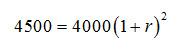
Okay, in our intermediate algebra class we just had a test on ‘quadratics’.  The material is a mixture of procedural and conceptual, with a few ‘applications’ included.  One of the applications involves compound interest (annual) for 2 years — so it creates a quadratic equation like this:

 Most students managed to write this (based on the verbal description and the provided formula).  The most common error?  Subtracting 4000 from each side, a disturbing error.  Since this problem was on a test, I did not have an oppportunity to discuss the error with the students to identify the source.  My primary suspect:  An early rule (early in education) to the effect that “large and small numbers mean divide, similar size numbers mean subtract”.  Every  one of these students can solve linear equations requiring division (like -4x=30), and most solved a quadratic involving a common factor (like 2x²=100).  What triggers  the “we must subtract” response?

In another class (the quantitative reasoning course), we have been doing geometry this week.  As for other topics, the formulas are provided — we are much more interested in the reasoning involved.  One of the problems dealt with finding the perimeter of this shape:

Two consistent problems came up.  First, students thought that ALL perimeter problems dealt with “P = 2L + 2W” … causing them to count the widths of the rectangle (which are interior, therefore not part of ‘perimeter’).  Second, even when convinced that some perimeter problems dealt with a different relationship, they did not see  why we should omit the perimeter (they still wanted to include the interior dimension).  Since I was able to discuss these issues, I have some idea of what is behind them. 

My point here is not to complain about what students do or don’t do, nor to suggest that they have had bad teaching  [I mean, beyond having ME as a teacher :)].  Rather, perhaps we need to think more about the root cause for many student difficulties: 

The basic problem is an oversimplification of a connected set of ideas down to a single ‘if-then’ clause.

Students are sometimes desperate to learn math, and we want to help them.  Too often, this results in only dealing with one thing (or one thing at a time) — which simplifies the learning, but which avoids building connections (contrast, similar).    The geometry instance of this is easily described:  by only dealing with one shape for ‘perimeter’ we encourage students to connect just one formula with that work — and to disconnect this from the concept involved (‘distance around’).   Our procedural work in algebra is even more prone to the oversimplification, because the correct learning is abstract about a combination of ‘properties’, ‘undoing’, and ‘maintaining value OR balance’. 

I’ve got to anticipate what some readers are thinking (due to that last sentence) … are manipulatives the solution for this problem in algebra?  Not really.  The research I have read on ‘kinetic learning’ suggests that this might provide some of the scaffolding to abstract ideas — but is counter-productive if the manipulative remains a focus.  This is a very difficult task, to shift from manipulative to concept; the stages vary with each learner.  If you can do manipulatives on an individual basis with continual feedback (conversation) with a highly skilled faculty, then I believe this can support better learning.   The skills involved are complex, and most faculty will not have them — including me; this is combining the skills of a cognitive researcher, qualitative researcher, and math faculty.  The problem with most manipulatives in learning is that the entire process is over-simplified to be practical in a group setting; a group of 3 students is too large, and possible 2 students is too large.

What is the answer?  We need to clearly articulate the few critically important learning outcomes in a math class (perhaps a dozen for a course), and provide diverse learning experiences around those outcomes.  “Simple” is not the solution; simple is part of the problem.  The solution is a planned sequence of activities to deeply explore the ‘good stuff’ of mathematics.

 
Join Dev Math Revival on Facebook:

WordPress Themes