Graphing and Models

One of the current trends in mathematics is ‘models’, often connected as ‘functions and models’.  What do students bring from their work on graphing in beginning algebra (often linear graphs) to this broader work?  Is this an easy transition?  Do we face challenges or hidden dangers in this work?
One thing I have noticed is that we often assume facility with basic graphing based on the linear function graphing included in a beginning algebra course.  A student can generate a table of values and use those to graph; a student can graph the y-intercept and use slope to find more points on graph to create the line.  I suggest that we face a significant gap in knowledge when we present a model to graph on their own.

This is the type of thing I am talking about:

A company finds that it costs $2.50 per glass, in addition to a basic set up cost of $80.  Write the linear function for the total cost based on the number of items (glasses).  Graph this function for a domain 0 to 100.

The typical beginning algebra class does not prepare students for this work.  Here are some of the gaps:

Typical Beginning Algebra has … Modeling has …
Slope in beginning algebra given just as a value (often a fraction) Slope in this problem is given as a rate (verbally)
Y-intercept in beginning algebra given as an ordered pair (or y-value) Y-intercept in this problem is stated as an initial value
X-values to use … -10 to +10 (domain) Domain stated verbally
Y-values to use … -10 to +10 Y-values determined by actual outputs
Scale for x-axis is provided (normally -10 to +10) Scale for x-axis must be determined (like 0, 10, 20, etc)
Scale for y-axis is provided (normally -10 to +10) Scale for y-axis must be determined (like 0, 20, 40, 60, etc)
Find two points, draw line Use table of values for points, draw line


This is not a scientific analysis of the knowledge needed for this problem; there are details at a finer grain of analysis that would show more gaps.

Essentially, this is a problem caused by “Bumper Mathing” (see an earlier post on that).  We constrain the graphing environment to the extent that the resulting knowledge is not applicable in any realistic situation.  We can do better than this.

“Graphing”, as a collection of related concepts and procedures, is fairly complex yet very useful … and is worth doing well.  We can certainly make more room in the algebra course so that students leave with good mathematics and knowledge that transfers.


 Join Dev Math Revival on Facebook:

Emporium and Faculty

Many colleges have implemented the Emporium model (or a related redesign), and others are getting ready to do so.  This post is not about whether those colleges should have done this method, nor about the validity of the methodology itself.  This post is about the faculty who find themselves in this situation — either working in the redesign themselves or being part of a department where the model is used.

Faculty concerns about these models relate to workload, college priorities, and professionalism.  Since a deliberate goal of these redesigns is often reduction in costs, faculty workload often shifts; instead of faculty having a class with 25 to 35 students, we find ourselves providing individual assistance (often in a computer lab) … sometimes for additional hours compared to the class. We may or may not be providing instructor-led learning opportunities (most often not), and we often work alongside tutors.  We usually have different professional responsibilities in these redesign models, and may have less opportunity to apply our judgment on assessments.

On those workload issues, I would remind faculty that these changes are in a larger context.  One of those larger factors is a trend to look at faculty in different ways within higher education; sometimes, this is a ‘faculty are the problem’ approach (a continuation of that them in K-12 education) … other times, people are listening to the ‘faculty of the future’ conversations will people envision vastly different responsibilities for faculty.  Those factors are parts of the forces that have led institutions and systems to adapt these particular redesigns; the question will be — are these models of redesign a viable structure for a new role of faculty?  In practice, fundamental changes like this are not a continuous function; an initial solution (Emporium or other redesign) does not provide sufficient benefits, so the solution is modified or replaced by an alternative model.  Due to other forces on developmental mathematics, I think it is very likely that the initial redesigns like Emporium will be replaced by a different model after a trial period (in most situations).

The college priorities that lead to this type of redesign place the highest value on efficiency and savings; for faculty, this produces some reasonable concerns.  How far ‘up the curriculum’ will these methods be used?  This set of values is also part of a larger context, one which will become even more evident in the next few years: ‘making college affordable’ in the political jargon.  We need to recognize that there is some validity to the view that higher education has become too expensive — less so in community colleges, but still true there.  Given that the median income is stagnant or slightly declining, any increase in cost for higher education is relatively ‘out of syn’; our colleges will have increased difficulty in adding revenue.  In some states, there is a path prescribed which would enable increased revenue — performance based funding, where increases are assigned based upon achieving more benchmarks (such as ‘completing’ developmental education).  These larger factors will be a problem for us, which means that we need to see them as an opportunity — how can we envision developmental mathematics so that we provide mathematically sound courses in a faculty-based system while reducing costs?

The faculty concerns about professionalism take different forms.  Faculty have told me that they are concerned for their job security when their college implements an Emporium (or similar model) and the faculty member is definite in their judgment that these are not appropriate models.  Faculty have told me that the move to a cost-saving redesign raises questions about being respected as professionals.   Faculty have also wondered whether the Emporium or related models reflect standards of the profession.    The fact that faculty in these models find themselves primarily providing individual help can create some cognitive dissonance about what ‘professional’ means for math faculty in developmental mathematics.

These concerns about professionalism have validity.  The larger context here deals with the history of our profession, both community college mathematics education in general and developmental mathematics in particular.  In general, we have not anchored community college mathematics education in our professional association (AMATYC).   AMATYC works hard through the efforts of incredibly dedicated colleagues; however, too few of us are active members … and few colleges change their mathematics curriculum based on AMATYC standards.  One factor here is that AMATYC is young, being about 40 years old — the process is slow; perhaps we will ‘get there’ in the next few years.

I need to address the professionalism for developmental mathematics in particular.  Because of the history of the field, we often see our courses as ‘improved high school courses’ and frequently hire current or former high school teachers to work (either full time or adjunct).  This is not a criticism of the individual teachers involved … however, this creates weaknesses in our profession, because we have not had our unique ‘voice’ for what developmental mathematics should be.  Our only ‘model’ has been “like high school”.  Essentially, we lack a professional ‘voice’.  Within the emerging models (New Life, Carnege Pathways, Dana Center Mathways), a common theme is the building up of the profession by emphasizing unique features and goals.  These emerging models provide a “this is not high school” message, and provide a framework for the profession; in these models, math faculty provide benefits and strive for goals with students that can not be reduced to doing lots of homework.

If you are one of the faculty either happy with doing an Emporium (or similar) redesign OR not-so-happy with being on such a project, I encourage you to do your best for the sake of our students.  Since there are larger forces involved, I believe that these redesigns will tend to naturally migrate to one of the emerging models over time.  If this change does not happen, we can hope that this is because the particular implementation is well designed to meet student needs.

Your best activity for the long term is involvement with your professional association — AMATYC for those of us in community college mathematics.

Join Dev Math Revival on Facebook:

Good Algebra

A recent comment on this blog basically asked the blunt question:  Basic math seems fine, but WHY did I have to learn algebra?  Mathematicians know that the word ‘algebra’ has multiple meanings.  In developmental math courses, the ‘algebra’ is usually various procedures relating to polynomials with integer exponents, with a collection of procedures for rational exponents.  The traditional algebra course packages material that is either (A) thought to be important for pre-calculus and/or calculus, or (B) what students should have had in high school.

Given this, my honest answer to the question is “There is no good reason for you to learn that algebra.”  If you need calculus, we probably are not building your understanding deeply enough; we certainly are not developing your reasoning in the way you will need in calculus.  If you do not need calculus, what you experience in ‘algebra’ is unrelated to any mathematical need you might have (such as science classes, technical careers, or life in general).

A reasonable follow-up question would be: “If this algebra is sort-of okay for calculus bound students (and could be improved), and this algebra is not helpful to most students in the course, WHY does the profession maintain these courses built around an amazingly consistent content package?”

I believe that we, as a profession, are committed to helping students … that we want to provide the mathematics they need.  We seem to be ignoring a logical analysis of the situation; there must be a strong reason for us continuing the traditional ‘dev math’ package.  I believe that there are two processes which combine to create this reason (an illusion of a valid reason):

Myth 1: Algebraic manipulation is evidence of either understanding or mathematical reasoning; quick and correct execution are evidence of better understanding and/or mathematical reasoning.

Myth 2: Developmental students can not be expected to deal directly with abstractions (core mathematical ideas); the best we can do is provide basic skills.

For my college, we use a common departmental final exam for these courses … a practice which I support.  However, the final exam for our intermediate algebra course is a set of 40 problems to be completed in 2 hours; the 40 problems represent 40 learning ‘objectives’ in the course … no item on the final involves applying synthesis or learning based on multiple objectives.  Good algebra seems to be seen as quick algebra … good algebra seems to be seen as repetitive algebra.

Every day, people make mathematical claims.  Whether it is economics, environmental, or political … somebody says “this is growing exponentially”.  Do our algebra courses help students understand this phrase?  Would students have any idea what conditions allow truly exponential growth … could students tell when the phrase is being used as a rhetorical tactic?  Does the phrase “we expect 150000 jobs per month to be added to the economy” imply an equation for our students … could they estimate when we will have replaced the number of jobs lost in the recession?  Given a graphical representation of either an equation or data, can our students determine if the representation is accurate or if it is distorted (by inappropriate scales, for example)?

Yes, we have good algebra we can and should provide to our students.  Good algebra is not quick algebra (except for experts like us); good algebra involves abstractions and reasoning, and can be messy.  We need to have faith that our students are capable of doing good algebra; if we do not have this faith and act on that, we are enabling students to be ‘bad at math’ as a way of life. 

It’s time for us to step out of our constraints created by history and myths … step out of that cage, and build a new experience centered on good algebra for our students.

 
Join Dev Math Revival on Facebook:

Math – Applications for Living XIII

We are at the end of the semester, so today is “final exam day” in our quantitative reasoning course.  Here are two problems from the final — both fairly complex, though students are doing okay with them.

First problem:

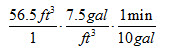
A family is filling a child’s “swimming pool” – a round pool that is 6 feet in diameter (3 feet radius). They will fill the pool to a depth of 2 feet, and will be using a garden hose to fill the pool We know that there are about 7.5 gallons of water in 1 cubic foot, and the hose will deliver about 10 gallons per minute. How long will it take to fill the pool, starting from empty, to the desired volume of water?

The formulas for volume are provided.  Students need to find the volume of the pool, and then use the units to correctly convert cubic feet to minutes 

This is similar to an earlier problem shared here.

The other problem is shorter, but more complicated in reasoning:

For a new play area, a school is using 200 meters of fencing. Find the area of a square enclosure, and of a circular enclosure, using this amount of fencing.

Again, formulas are provided.  Students need to find the side of a square with perimeter 200m … then the area; the circle is more challenging … students need to find the radius given the circumference, then find the area.  I have used this problem (with different quantities of ‘fencing’) for a while, and have been pleased with the reasoning students are showing.


 Join Dev Math Revival on Facebook:

WordPress Themes