At the AMATYC conference today, I did a presentation called “Bringing New Life to Your Developmental Mathematics”. I’ll post the materials I used.
The basic presentation (PDF format, from the power point slides): Bringing New Life to Developmental Mathematics 2012 FINAL version
The handout (vision of the curriculum, references; in PDF format): References_BringingNewLifeSession_AMATYC2012
We also used two “prezi” presentations during the session:
Developmental Math: What Is http://prezi.com/se9rgi2ezfer/dev-math-what-is/
New Life Curricular Vision http://prezi.com/27_erw7l0d67/new-life-curricular-vision/
After being active for about 3 years, the New Life model is maturing. This post will describe the changes to the model that are evolving, and show the updated graphic.
The model has always focused on two developmental math courses to replace the current 3 or 4. The first New Life course (MLCS) has been well received in the profession as shown by a number of pilots, some books in development, and sessions at the AMATYC conference this year. However, the second New Life course suffered from a less-clear vision and purpose; in our discussions, we discovered part of this was the name we used … “Transitions” did not communicate much (it was short for “Transitions to College Mathematics”). After some discussion, we are switching to the new name “Algebraic Literacy” for the second course; this name provides a parallel structure to the first, and suggests that the primary content is algebra (true). Like any course name, Algebraic Literacy does not tell the entire story; however, we are confident that the new name will work better.
A second problem with that course, the part of the model connecting MLCS with college algebra and courses at that level, is that we did not make it clear that our course would be appropriate for both STEM and non-STEM students. Our learning outcomes for this course have always included ‘STEM-boosting’ outcomes to indicate preparation for pre-calculus; we are emphasizing that more. In addition, the visual for the model (below) now shows better connections to college mathematics.
The sequence in our model (MLCS to some college math, MLCS to Algebraic Literacy) originally did not emphasize that students could place directly in to Algebraic Literacy. This access issue is critical … a basic premise of our work is that we need to create shorter paths; we always intended to have the direct placement option into Algebraic Literacy. Unfortunately, this was not stated in the visual aid nor stated in most documents about the model.
The other issue we are adjusting for is the need for change in traditional college level mathematics — college algebra in particular. The Algebraic Literacy course creates the same types of reasoning that a reformed college algebra course would seek to build upon; this is one of the strengths of the New Life model. The new visual includes a new path specifically for reform college algebra.
Here is the updated visual:

Join Dev Math Revival on Facebook:
One of the macro problems in our profession is the relative ignorance we have (as teachers) of sound scientific evidence and theory related to the target of all of our work: the human brain. In particular, we want our students to show that they learned something by using their memory of information; however, we design our efforts around the surface features of ‘doing math’ with too little attention to how a person (like a student) will actually remember information.
I am talking here of ‘memory’ in the scientific sense: something is stored in the brain, and memory refers to both this storage and the retrieval. We might get “memorization” confused with “memory”; one refers to a specific process for building memory … the other refers to all factors involved.
Through a connection (on LinkedIn, of all places) I encountered a surprisingly good summary of research on memory. The readable source is http://www.spring.org.uk/2012/10/how-memory-works-10-things-most-people-get-wrong.php which is based on a more technical anthology of research on memory.
Three of my favorite summary statements are these:
Forgetting helps you learn.
Recalling memories alters them
When recall is easy, learning is low
Other items in the list deal with learning in context and productive organizations for learning new skills. All items in the list have direct applications for our classrooms and learning mathematics.
We all have our preconceptions about how memory works. As teachers, we develop ‘intuitions’ about our students and their learning. Like most domains, intuitions are valuable but actually incorrect more often than not; partially, this is due to the fact that organic processes have a large number of variables.
I encourage you to at least read the 10-item summary; that article contains a link to an online copy of the anthology of original research … you might find that interesting as well.
Join Dev Math Revival on Facebook:
The latest MAA Horizons has a great opinion piece by Paul Zorn called “Necessary Algebra” (see http://horizonsaftermath.blogspot.com/ to read it). In our age of change in the curriculum, we need to keep our eyes on the entire system and the important goals. To the extent that we want people to be able to reason mathematically and apply their knowledge in powerful ways, algebra is not just necessary … it is essential.
In his article, Paul Zorn gives this informal definition of algebra:
You can manipulate unknowns and knowns to solve equations.
I had another of my discussions with a student about the problems of “PEMDAS”. This student was having great difficulty keeping straight the algebra we are learning (fairly traditional at this point), partly because the rigid application of PEMDAS got her through the prior math course … and now she did not have a single pre-determined set of steps to get correct answers. Algebra is all about the legitimate choices we have in working with quantities (with and without unknowns). Reasoning is dependent upon both knowing that there are choices and understanding some of the implications of those choices.
One of the strong trends in our age is the ‘contextualization’ of learning, and the related method of ‘problem based learning’. Algebra, and mathematics in general, is both practical now and cognitively useful in the future. Paul Zorn points out that we typically don’t use much of the specifics from our education in any everyday job — whether we are talking about math, sciences, history, or almost any domain of knowledge. To limit our education to the immediately practical is to take education out of our classrooms; education is about building capacity, not just about providing methods to solve specific problems that can be understood at the moment.
My own approach to algebra, and mathematics in general, is this:
I always want to include some useless and beautiful mathematics in all of my classes.
Education is the exciting work of strengthening human brains by exploring domains of knowledge. Algebra has a role to play. As we reform our curriculum we need to keep algebra as one of the core domains of knowledge.
Join Dev Math Revival on Facebook:
 Professional Development | Jack Rotman |
  November 8, 2012 1:05 pm |
  Comments (0)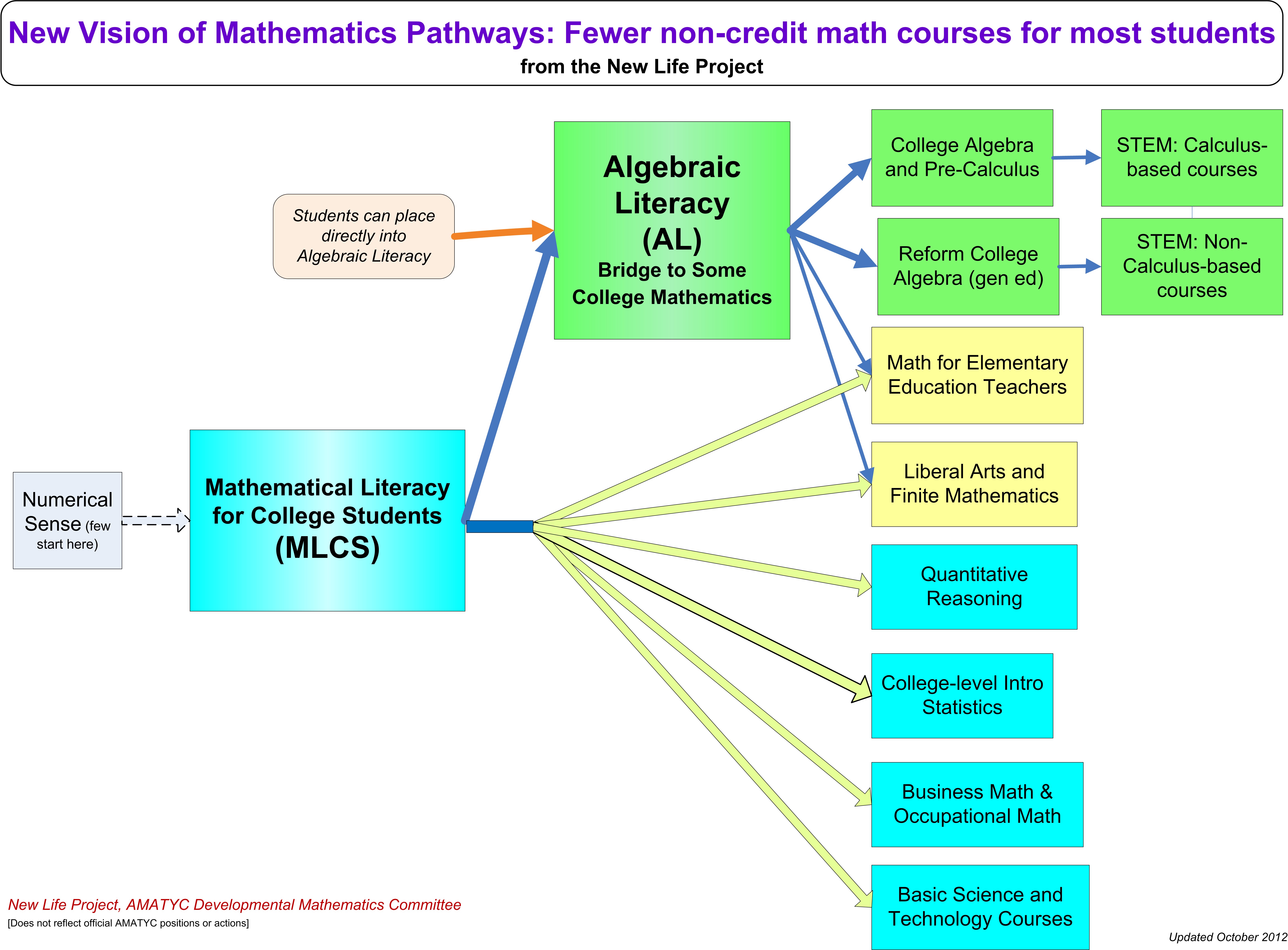
 Subscribe
 Jack Rotman
NOTE: This blog will become 'inactive' on January 1, 2020.
Jack Rotman
NOTE: This blog will become 'inactive' on January 1, 2020.