Math Lit, and Pathways for Faculty

On my bookshelf, I have copies of two of the best math books available today:  Math Lit (Almy & Foes) and Math Literacy (Sobecki & Mercer).  Here are cover images:
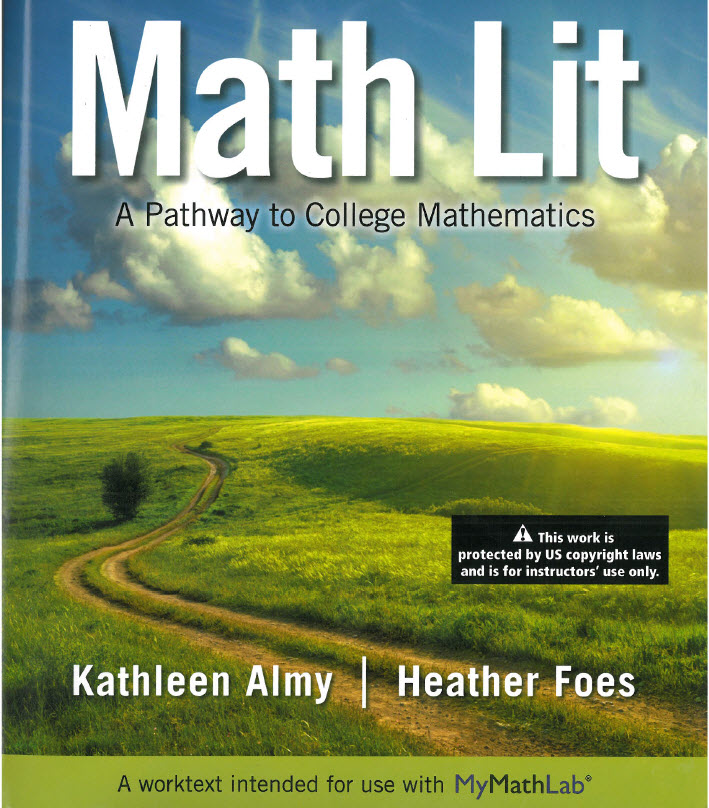
Almy Foes Math Lit Cover Feb2014


Mercer Sobecki Math Lit Cover Feb2014


Three years ago, this course was not offered anywhere.  As of this month, we have over 40 colleges offering the class with over 160 sections; Mathematical Literacy is an alternative to a beginning algebra course.  With the hard work of faculty, support from their colleges, and wisdom of publishing companies, the New Life Project continues to make a difference in our profession.

The work continues; the next course to be developed is Algebraic Literacy.  This alternative to an intermediate algebra course offers similar advantages; take a look at the “Missing Link” presentation (https://www.devmathrevival.net/?page_id=1807) from last fall’s National Summit on Developmental Mathematics.

I am seeing this progress as part of the pathway for us — a pathway for mathematics faculty.  We are moving from an accidental collection of relatively isolated topics with little benefit to students … to a deliberate design of courses containing mathematics to be proud of, with content designed to help all of our students.

In the process of moving from the old to the new, we are on a pathway ourselves.  We can become inspired by the design, gain skills in teaching mathematics, and experience a course that connects meaningfully to students.  Instead of being seen as “the last course to take, the one that stands in the way of graduating”, we can provide courses that show benefits to students earlier in their program.  Many students will find our new courses enjoyable; they will leave with a more positive view of what mathematics is.

We are on the path that leads to a mirror, a mirror which says “We do important work, and students benefit; be proud!”  I hope to see many of you on this trail.

 Join Dev Math Revival on Facebook:

Applications for Living: Growth, Decay, and Algebra

We are taking the second test today in our Applications for Living class.  The first test covered ideas of quantities and geometry, including dimensional analysis.  This second test covers a variety of ideas, mostly related to percents.

Everybody is the class has completed two courses which include some work with percents.  For a few, it’s been several years — however, that does not matter.  All students get a fresh start on percents in this class.  The work is intense for this test, and then we return to percents towards the end of the semester when we cover exponential models.

The initial struggle starts when we deal with unknown base numbers, when we know the new value after a known percent change.  like this:

In 2014, there were 20000 people voting.  This was a 10% increase from 2012.  Find the number voting in 2012.

Students really want to find 10% of that number in the problem, and then subtract.  Initially, they argue that this method is valid.  After doing a few where we know the base, most accept that we can’t do the multiply and subtract method.  To help, we take a growth and decay approach (though the words are not emphasized).  For the voting problem, we work on seeing a 1.10 multiplier on the base (unknown).  For a discount problem, we work on expressing “15% off” as a 0.85 multiplier.

We then use a sequence of percent changes.  One of the early ones is:

We have $50 to take our family out to dinner.  There is a 6% sales tax on the total price of the food, and we always leave a 15% tip (15% of the total with the tax).  How much can we spend (for the price of food)?

The success rate for this problem is very low; even with help, few students can see how to work this problem.  Over the next few days, we see other expressions like  “1.15(1.06n)=50”.

When we start compound interest, we begin with a basic idea:  A = P(1 +APR)^Y.  We talk about compound interest as a sequence of percent increases.  Without any preparation, students encounter this problem:

At one point, home prices were increasing 10% per year.  What would the price of a $100,000 home be after 5 years?

The majority of the students saw the basic relationship, and used the compound interest formula (for annual compounding) on a problem that did not involve interest.  That type of transfer is a good sign.

This does not mean that students really get the percent to multiplier idea.  One of the questions on today’s test is one that I have mentioned before:

The retail cost of a computer is 27% more than its wholesale cost.  Determine which of these statements is true.

The options for this question include ‘retail cost is 27% of the wholesale cost’, and ‘the retail cost is 127% more than the wholesale cost’; these are frequently selected in preference to the correct “the retail cost is 127% of the wholesale cost”.  Building new pathways in the brain is easier than repairing old ones.

Our course is not heavily algebraic … except to use algebra as a way to express relationships.  Our work with growth and decay culminates in exponential models, where students need to go from “the prices are falling 4% per year, and the current price is $50” to the model y = 50(0.96)^x.  We like to look at this model as being related to the compound interest formula.

This strand of “percent change” (growth, decay) runs through our course, which I am pleased with — the world involves many exponential models, which means that students will need to be adept in using them in science classes.  One of the later problems we look at is:

If there are 50,000 cheetahs today, and the population is declining 8% per year, how many cheetahs will there be in 10 years?  How long will it take to have just 500 cheetahs?

We look at both of those questions from a numeric perspective.  The first is a simple calculation; the second is solved numerically from the graphs.  [We also learn how to graph such models, including the design of appropriate scales.]

A single post can not tell the entire story of any topic.  However, I’ve tried to include some basic benchmarks in the story of ‘growth, decay, and algebra’ in an applied math course.

 Join Dev Math Revival on Facebook:

Math is Different

A student applies for a community college, having set a personal goal of earning an associate degree in a field with good employment prospects.  The college informs her that she needs to take a placement test to confirm that she has her basic skills in science and history; clearly, a student needs to have those basic skills before taking college courses that involve science or culture.

The student, Lindsay, takes the tests; she learns that she has to take two remedial science classes and one remedial history class before she can start her program; these courses correspond to 8th and 10th grade science and to 9th grade history.  With relief, she learns that she does not need to take a course like her 12th grade mathematics.

What’s that you say?  This is ridiculous and untrue?  Yes, clearly I’m making this up.  However, it is possible that our approach to mathematics in college is just as ridiculous.

We say, and do many others, that “Math is Different”.  Of course.  Does the set of differences justify the punitive approach we use for mathematics?  We place students in boxes, each with a label for the degree of deficiency.  These boxes have no known connection to college courses, justified by a belief that ‘high school’ must be mastered before ‘college’.  The most common math courses taken by college students were never designed to provide benefits in college; they are copies (sometimes poor copies) of outdated school mathematics imposed on students.

Do we have students who truly need remediation in mathematics?  Absolutely; the rate is probably large — over 20% of incoming students probably need some remedial math course before they have a reasonable chance of success in college courses in science or mathematics.  Some students come to a community college with extensive needs in mathematics, and need help with number sense, proportional reasoning, algebraic reasoning, basic ideas of geometry, and more.  Many come to us with weak skills in algebraic reasoning and basic geometry — combined with needs for other areas of mathematics.

Placing students into a sequence of courses covering years of school mathematics makes no sense in college.  Research suggesting that many students are equally successful placed directly into college courses reflects a design problem, as much as ‘remedial is not working’.    As an analogy — I had a flash drive stop working this week.  Now, a flash drive needs a port and an operating system; there is a sequence of things here.  Our approach to remediation is like installing a new cover on the flash drive so it looks more like the computer, instead of making sure that the system works together.

Redesign of developmental and introductory college math courses is not enough.  Instructional delivery systems will not solve our problems.

We need to look at root causes and basic relationships so we can identify student capabilities that will make a difference.  In developmental mathematics, the New Life Project has done this type of analysis; take a look at http://dm-live.wikispaces.com/ for information.  Not as much has been done for basic college mathematics (college algebra, pre-calculus, etc); the MAA CRAFTY materials provide a start — see http://www.maa.org/sites/default/files/pdf/CUPM/crafty/CRAFTY-Coll-Alg-Guidelines.pdf  for information.

Math is different; students are different.  Take a look at the differential pass rates among groups of students.  The types of students most of us really want to help — those lacking prior success (predominantly poor and minority students) have significantly lower course pass rates in our current courses.  Sometimes, the differential is so severe that completion of the sequence is a trivial number of such groups.  The conditional probability of “need 3 developmental math courses AND is black/African American” is somewhere around 5%, compared to about 18% for all students.  A cynic might say that the primary purpose of developmental mathematics is to make sure that the high paying jobs stay in the hands of the ‘haves’.  I do not believe that we want to block the upward mobility of students in our communities.

We need new math courses, courses designed to provide benefits; courses designed to provide equity to our students.

All other improvements in mathematics at colleges will be temporary relief at best.  The system is not designed to succeed, and that is the problem needing our attention.

 
Join Dev Math Revival on Facebook:


Should ANY Adult take an Algebra Class?

In Michigan, we are working through a process to update the math courses that can be used to meet general education requirements.  We are using pathways concepts, and face the issue of intermediate algebra … and college algebra.  This has led me to ponder the question — is there a good reason for any adult to take an algebra class?

College courses, overall, are either for general education or for specialization.  Developmental math courses are a subset of the general education courses — they are pre-college level, and not specialized.  I know a few places have integrated developmental math into occupational courses; however, the majority of us do our developmental in a general context.

There is no need for an ‘algebra’ course in general education, whether developmental or not.  At the pre-college level, we focus on the mathematics that students need in college level courses.  Certainly, this preparation needs to include algebraic ideas, reasoning, and processes.  However, this basic algebra is a tool used in combination with other mathematics — whether geometry, statistics, networking, or other.  A developmental mathematics course might have more algebra than other domains, but will never serve students well if the only content is basic algebra.  Mathematical reasoning is not isolated bits of knowledge.

At the college level, a general education course is meant to provide breadth to a student’s understanding of the world.  An intense focus on algebra in a course for this purpose is misleading at best; more commonly, such an intense focus on algebra for general education creates barriers to completion with a course widely viewed as being disconnected from the real world.  A general education math course needs to be diverse, and show relevance.

The other broad category is ‘specialization’, usually related to a particular program or major.  The ‘algebra’ we are using in this discussion is a subset of polynomial algebra, which is nobody’s specialization; none of us teach such algebra courses because we were inspired to earn an advanced degree in the content.  This specialization, practically speaking, is justified by the study of calculus.  Even in a traditional calculus course, algebraic understanding is just one of the basic factors in success.  Visualization, flexibility, and breadth of knowledge are important as well.  We often provide separate courses in ‘college algebra’ and ‘trigonometry’ (with little geometry in either one), and then wonder at why students can not integrate their knowledge and apply it to new situations.

With all of the intense focus on developmental mathematics, we tend to not think about the curriculum at the next level … and whether it serves students well.  These courses in college algebra, trigonometry, and pre-calculus have completion rates that ‘compete’ (in a negative sense) with developmental courses; only the small ‘n values’ involved keeps this problem out of the attention of policy makers and grant-making foundations (is there a difference between those two?).  We have much work to do.

I do not believe any student should be faced with an algebra course.  Mathematics is much more interesting than that, and more diverse.  Let’s put a variety of good stuff (good mathematics) in every course a student takes.  We might even inspire significant numbers of students to take more mathematics.

 Join Dev Math Revival on Facebook:

WordPress Themes