Our Students, Respect and Appreciation

So, I received a phone call today that really upset me.  Like most teachers at any level, “my student” is not just a reference … it describes the connection we feel to the people in our classes.  This phone call made me think, and changed how I think about my students.

This student (call her “Tami”) is in my beginning algebra course.  She’s not doing especially well, and has missed a class or two.  When she was not in class today, I did not think that much about it.

Tami left a message on my phone while I was in class.  I did not catch all of what she said, so I called her back and this is what she said:

I’m sorry that I was not in class today.  I wanted to make sure that you would not drop me.  I was in the emergency room this weekend because I got stabbed in the neck.

I thought about that a little bit … here is a person who had a real threat to her safety and continued survival, and she’s calling me about her math class.  How do my flimsy excuses for not taking care of responsibilities stack up against that?

Some people might be thinking “Jack, you’re so naive … did you think that the student might be either lying or ‘enhancing’ the truth?”  Actually, I did think of those possibilities; I’ll know more when I see Tami in class.  In the meantime, I chose to trust my students by default; that is not always warranted, but it sure helps in the efforts to build a positive classroom environment.

Sometimes, we are very quick to presume that students do not come to class because they don’t care.  Certainly, that is the case for some students … though I have more students who attend class in spite of the fact that they don’t care.

I realize that this is not a unique experience; you might have had a similar experience where a student had a ‘survival’ level experience and still showed some commitment to their math class.  However, the experience reminded me that many of our students deserve our respect and appreciation for dealing with the huge challenges in their lives … and still try to work on their math class.  For some, math class becomes their one safe space in a world of threats and chaos.

 Join Dev Math Revival on Facebook:

Can ANY Sequence of Math Courses Succeed??

We share a commitment to student success … we work hard to help students reach their goals.  Sometimes, it just seems like that success is very rare.  We’re told by many sources that most students fail to reach their goal, especially if they are placed into the “dead end” (developmental mathematics).  What’s the problem?  #CCA  #pathways  #collegemath

Mathematics in college consists of sequences of courses.  Historically, the primary variable was the ‘exit point’ (the student’s last math class); recent work has created a more subtle solution where the prerequisites are variable … not all college-level courses require intermediate algebra.  We still have sequences.

The extremes of a sequence design are easily seen as failures.  At the one extreme, we might have a sequence of 4 prerequisite courses prior to the ‘one that counts’; even if we have an astounding pass rate (80%) and perfect retention (100% to next course), the net result is 41% start the college course.  The more reasonable pass rate (70%) and retention rate (80%) mean that about 12% start the college course.

At the other extreme, we have no prior courses … it’s a sequence of one course, the college level one.  That’s what the radical “co-requisite remediation” advocates suggest (and some states try to implement).  In this approach, 100% start the college math course, so even if just 30% pass it’s a gain over the long sequence.  Most of us do not support this type of policy.

So, the question is this:

Can ANY Sequence of Math Courses Succeed?

As for many human endeavors, it is far easier to create something that does not work than something that does.  Here are some principles for designing for success.

  • Courses copied from another context will not support success in the sequence.

Developmental mathematics is full of course copies … basic math copied from 8th grade, beginning algebra copied from algebra I, intermediate algebra copied from algebra II, etc.  These remedial courses are part of a different tradition: students should be ‘college ready’ so we provide courses to remediate high school.  College algebra, erroneously seen as pre-calculus, is also a copy of a course.  These courses have nothing to do with success in the sequence.  We create some coincidental features for success in the algebra courses, but the entire package is doomed.

  • Arithmetic is too difficult for college

Learning arithmetic involves applying properties of real numbers, standardized rates (percents), and solving fractional equations (proportions).  These advanced topics might make sense after a good algebra course, but certainly not before.  Saying that arithmetic is a prerequisite to algebra is like saying that running is a prerequisite to walking.  A course on arithmetic is doomed; either the content is too advanced … or we take all of the arithmetic out and just deal with correct answers.

  • One course at the developmental level should be enough for at least 80% of the students.

Too often we think about “what the student does not know”, instead of “what is needed for success”.  We get trapped in to a process that tries to fill in all ‘holes’.  Being ready for success in a college level math course does not involve ‘everything’.

  • Capabilities are just as important as skills.

In the traditional sequence, we do exclusively skill work; sure, we include ‘applications’ with the thought that these will improve something (though we are not sure what).  Our courses often delay intense work on reasoning until the calculus I course.  General reasoning is one of the ‘capabilities’ required for success; we might even focus on the 5 strands of mathematical proficiency.  Other capabilities are number sense, proportional reasoning and algebraic reasoning.

  • Good mathematics should start from the first day of every class.

The traditional sequence directly says “you are not ready for the good stuff yet; let’s see if you make it though this n-course sequence and then start good mathematics”.  I leave “good mathematics” as an undefined term.  If you look forward to teaching it and are proud of the mathematics, you are probably doing good mathematics.  One trait of good mathematics is likely to be that connections are built for each idea.


The AMATYC New Life Project has advocated a curricular model consistent with these principles.  We’re not alone in doing so; the Dana Center New Mathways work also does a good job.  The old courses (developmental and college algebra) need to be replaced by courses designed to succeed.  The New Life  math courses emphasize important mathematics with a plan to efficiently get students ready:  Mathematical Literacy, and Algebraic Literacy.   [I’m doing a session at this year’s AMATYC conference on the Algebraic Literacy course.]


Join Dev Math Revival on Facebook:

Word Problems and Reasoning … Rule 42

In my introductory algebra class, I gave a quiz today; this quiz included this question:

Some milk having 1% fat is being mixed with milk having 4% fat; the mixture will be 100 gallons, and have 2% fat. How much fat is in the mixture?

Now, I always review the quiz right after we complete … so sometimes I get to see some interesting reactions.  Please understand that all of the items on this quiz dealt with ‘puzzle’ word problems (not much real context), so students were not feeling mellow … many were feeling quite a bit of stress.  Besides the stated reactions about the question being ‘tricky’, I got to see students respond when they realized what they were supposed to do.

A typical wrong response to that question was to start working on solving the ‘problem’ they expected to see … how much of each type is supposed to be mixed?  Quite a few of these students wrote the correct equation including the “0.02(100)” for the milk fat in the mixture.  However, not many of these students realized that they had the answer to the question.  Our entire approach to these mixture problems in the class prior centered on “value = rate(quantity)” as a basic concept.

I was pleased that some students just wrote down the answer (2 gallons), perhaps with a note “0.02(100)”.  These students got that basic idea that value = rate(quantity).  I’d say that this 20% compares with the 40% who tried to ‘solve’ the problem but never realized that they had the answer … and the 40% who had no idea what to do.

One of the culprits for the difficulties is the inadequate way percents are done in math classes.  We focus so much on correct answers that we do not make it clear that percent is not ‘how much’ … and that every percent is a rate which is multiplied by a base.  For my question on the quiz, just knowing “percent times base” is sufficient to get the right answer (and show some understanding).

The other culprit is based on the high-anxiety suffered by students when faced with “word problems”.  I’d like to think that my class presents word problems as a reasonable use of language and algebra, even if the problems are either trivial or uninteresting.  Further, I’d like to think this positive approach helps students be more comfortable dealing with these problems.

Some readers might wonder “why do those puzzle problems at all” … perhaps we should “make the content relevant to the students”.  With all of the focus currently on ‘alignment’ and ‘context’, those are reasonable questions.  Based on my understanding of the learning process (along with some sociology), the question is not easily answered.  I am pretty sure that covering ONLY relevant applications is not a good idea for a mathematics course serving a general purpose; it might work in occupational math, or specialized math, but not so much when there is so much diversity among the students.  One student’s relevant problem is another student’s puzzle problem, and another student’s life survival issue; in addition, high context in problems can localize the learning and interfere with general reasoning and understanding.

So, I will continue to work with quite a few puzzle problems in our introductory algebra course — and keep a focus on the basic ideas that allow us to understand and solve them.  My goal is to help students develop a deeper understanding and develop connections.

 Join Dev Math Revival on Facebook:

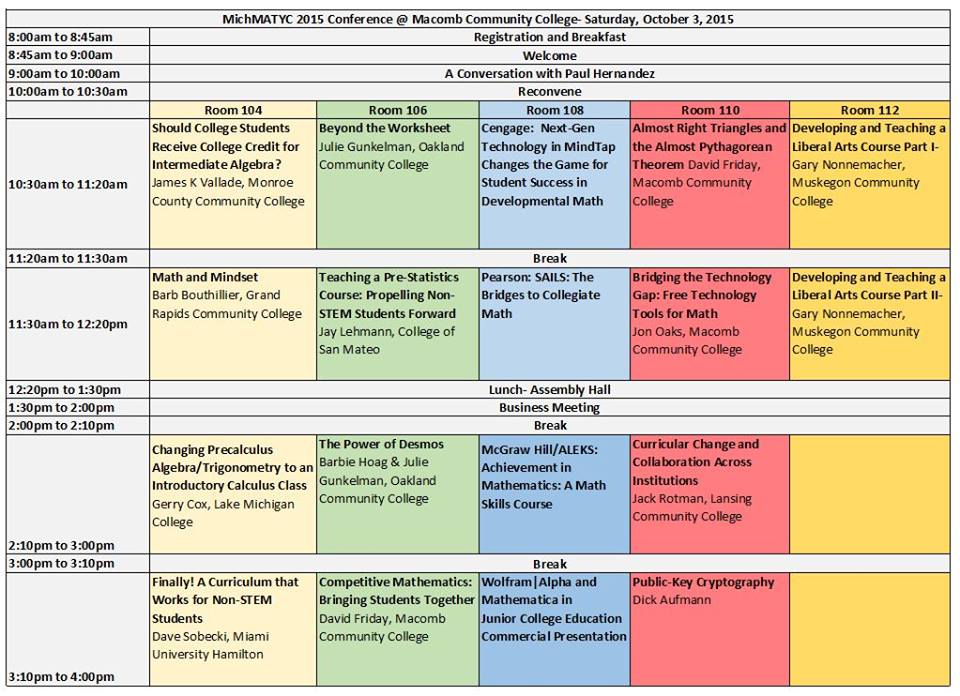
MichMATYC conference schedule (Oct 3, 2015)

Here is the session schedule for MichMATYC 2015 at Macomb Community College (Oct 3):

MichMATYC 2015 session schedule

WordPress Themes