Clarifying the Curricular Vision of the New Life Project

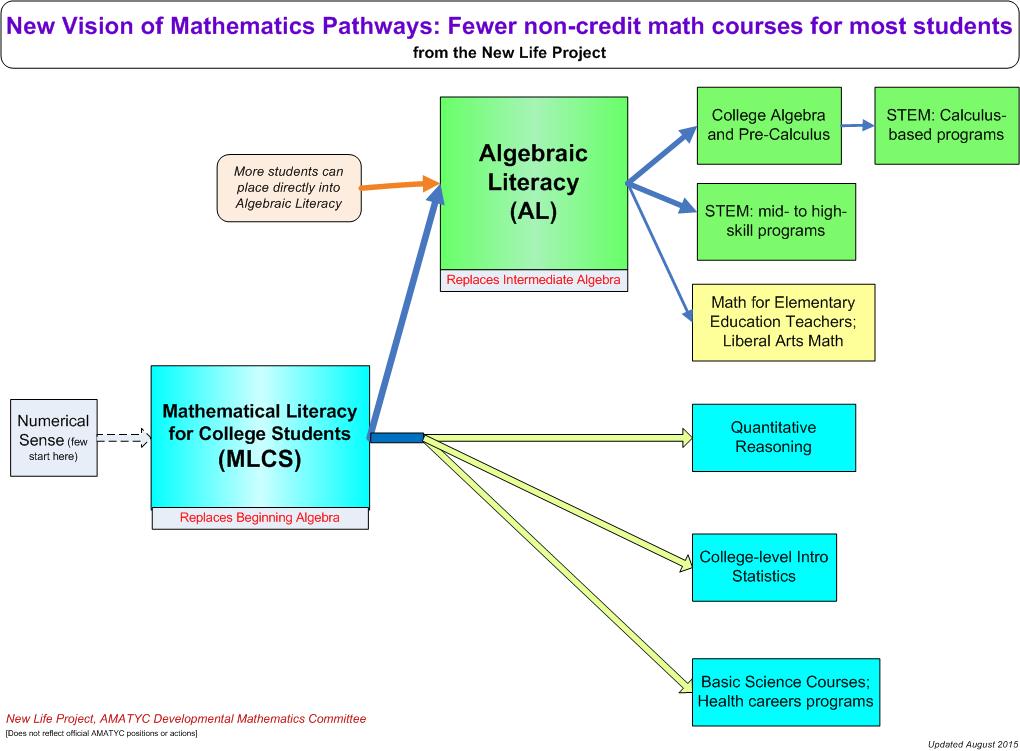
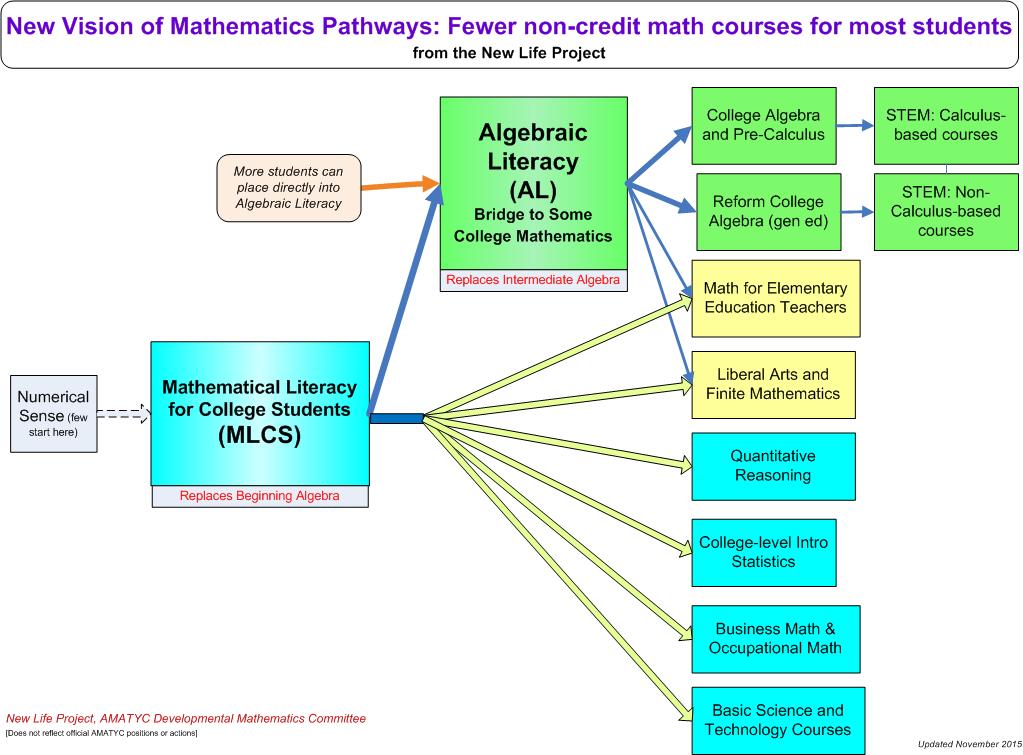
The ‘map’ showing how the New Life Project courses (Math Literacy, Algebraic Literacy) fit into the collegiate mathematics curriculum has been updated.

Here is the version intended for mathematics professionals:
New Math Pathways General Vision 11 18 15


We also have a ‘simplified’ version, intended for those outside of mathematics departments:
New Math Pathways General Vision simplified 11 18 15


These new versions continue the same concepts.  The clarifications involve (A) the eventual use as replacements for the traditional developmental mathematics courses (from 3 or more, down to 2)  and (B) placement into algebraic literacy (more than can go into intermediate algebra).

 Join Dev Math Revival on Facebook:

Too Many Math Courses!!

Have you got course(s) in … basic math … arithmetic … pre-algebra … fraction modules … decimal modules … etc??  Although some colleges and a few states have eliminated courses at this level, the vast majority of colleges still have one or more.  One is too many!  #acceleration #FinancialAid

Federal financial aid guidelines prohibit a course to count for enrollment levels unless it is at least at the high school level; courses below high school (K to 8) can not be used.  See https://ifap.ed.gov/fsahandbook/attachments/1415Vol1Ch1.pdf

My institution is currently going through a process (intensely so) dealing with our single course at that level (pre-algebra).  Our department has been asked (about every 10 years) to classify developmental courses as ‘high school’ or ‘below high school’.  The most recent request resulted in our best answer at this time: pre-algebra is at the K-8 level.  That was mostly true 10 years ago, and the answer is even clearer when the Common Core standards are considered.

Does your college follow this rule?  You might know already, but be aware that all institutions can be subject to a financial aid audit; violations can result in financial penalties up to and including loss of all federal financial aid money.  Fines are the most common penalty, from what I’ve heard.

Do you have 3 or more courses below intermediate algebra?  Two of these are likely to be ‘elementary level’ (non-federal financial aid), and one ‘high school’ (beginning algebra).  Three courses at that level creates a practical problem for students (completion), a financial problem for your institution (financial aid audit), and a moral problem as well.

The Math Literacy course is designed to have a minimal prerequisite (basic numeracy).  Some colleges use Math Literacy with a lower placement cutoff than beginning algebra; some offer Math Literacy without any math prerequisite at all.  To me, this is a situation where co-requisite remediation makes a lot of sense.  The prerequisite knowledge is a fairly small set, and the range of ‘gaps’ is therefore more limited than it would be in a higher-level course.

For some of us, ‘arithmetic’ is the most common placement level for new students in our college.  I’ve heard up to 36% in that placement, with my college’s rate a little lower.  In all of the research I’ve seen over the years, one thing has been consistent:  courses before beginning algebra do not benefit students in terms of passing subsequent math courses (in general).  Our instruction and learning is often the least sophisticated at this level, and student motivation tends to be pretty low.

Let’s agree that eliminating courses below Math Literacy (and beginning algebra) is a really, really good goal.  The problems have other solutions within our reach, and our students deserve better than they are getting now.  The federal financial aid rules provide an added incentive; however, we have sufficient rationale from other considerations.

 Join Dev Math Revival on Facebook:

Who needs developmental math? Who needs remediation?

In our beginning algebra class, we started our work in ‘exponents’.  I use an activity (guided, discovery) to start this work and talk with students and groups as they answer the questions.  The range of questions and confusion is both encouraging and discouraging.  Some of the questions showed thoughtfulness and insight; others indicated a naive knowledge of our language system. #placement #tests

A large component of the issues relate to “grouping”, in 3 categories:

  • The meaning of required, shown grouping
  • The meaning of optional, shown grouping
  • The meaning of implied grouping

Many of us have commented on an example of the last group:   -5², where the implied grouping exists on the base (5) not the opposite.  Students do struggle with this, and … on its own … this type of problem is not worth the trouble.  However, many of the same students misinterpret 5x²; when a value of x is provided students will square the 5 as well as the x … if the replacement value is negative, students will either leave off parentheses on that value or write the parentheses but not use them in evaluating.  The implied grouping is a key feature of mathematical languages, and it harms students that we are not consistent in the meaning of implied grouping.  [Just think about what sin² 3x means … there are two implied groupings in that expression, and both are inconsistent with almost all other implied groupings.]

When a problem had optional grouping shown, as in (5xy)(x²y³), students do not always understand that the meaning has not changed … and often, they think of a different process (like distributing) when they would not if the problem had no grouping at all.  Another example would be (5x + 3) – (2x – 5) [required grouping on the 2nd expression] when the student distributes the ‘negative’ and writes (5x + 3) (-2x + 5) … and proceeds to multiply; that’s a case where we would say the grouping is optional but correct with the ‘plus’ between the groups.

So, what do these comments have to do with ‘needing developmental math’ or ‘needing remediation’?  These misunderstandings are not gaps in knowledge, nor forgotten information … they are wrong ideas (called ‘baggage’ by some colleagues).  Wrong ideas are known to be resistant to instruction; the most common outcome is that the wrong ideas are temporarily covered up by memorized correct information but then re-appear in the behavior after a short period of time.

Much criticism has been leveled at the placement tests we use.  The words “evil” and “invalid” often are included in statements about those tests.  However, the problem is us not the tests.  The tests are constructed to meet ‘market demands’ … we have told the companies that we need to measure skills, so that is what we got.  The problem is that skills are a very poor way to identify students needing either a developmental math course or a remedial math course.  Missing a skill problem can be caused by either a wrong idea OR a forgotten procedure, resulting in much ambiguity with scores.

Developmental mathematics is not going away.  Change is happening … the new courses like Mathematical Literacy and Algebraic Literacy focus first on developing right ideas about the mathematical objects then on procedures.  What we need is a new set of specifications for placement tests to determine who needs a course versus those who are either ‘ready now’ or ‘have forgotten some’.  I suspect that the ‘entrance tests’ (SAT, ACT) are better measures than the placement tests because the ACT & SAT are not as focused on skills.  We need placement tests that identify wrong ideas as well as some fundamental skills.

 Join Dev Math Revival on Facebook:

Co-Requisite Remediation in Tennessee

Has Complete College America (CCA) collaborated with the Tennessee Board of Regents (TBR) to create a great solution … or, have they inflicted an invalid model on the students of the state?  I suggest that “data” will not answer this question. #CCA #CorequisiteRemdiation

To summarize some key features of the Tennessee plan in mathematics, implemented state-wide this fall (2015):

  • All students are placed in to college-credit mathematics
  • If the ACT Math score is below 19, that college level math course will be statistics or quantitative reasoning
  • If the ACT Math score is below 19, the student is required to enroll in a co-requisite ‘support’ course
  • This co-requisite support course involves all developmental math learning outcomes

These elements are taken from a TBR memo (http://www.pstcc.edu/curriculum/_files/pdf/cdc/1415/Features%20of%20Corequisite%20Remediation%20-%20Memo.pdf)

From what I can see, actual practice is pretty close to this plan … learning support classes are paired with a QR course and an intro statistics course (but not college algebra or pre-calculus).  The learning support courses list topics from arithmetic, algebra, geometry and statistics.  I noticed that the QR courses tend to be more of a liberal arts math course — set theory, finance, voting, etc (the course is called ‘contemporary mathematics’).  In the 4-year college setting, this type of liberal arts math course is usually offered without any math prerequisite.

The initial data from the Tennessee pilot look very good; in fact, my provost is smitten with the Tennessee program, and wants us to consider doing the same thing.  I think the plan will “work” fairly well in Tennessee because of the non-symbolic nature of their QR course (intro statistics is notoriously non-symbolic, in the algebraic sense) … and the fact that they block students from STEM.  [They also had an inappropriate prerequisite on the non-STEM courses; see below.]

In Michigan, we have tried to establish 3 paths in math … college algebra/pre-calculus, statistics, and QR.  For statistics and QR, we have established a ‘beginning algebra level’ prerequisite (algebra or math literacy).  This level maps roughly to an ACT math score of 17, and we require more algebra in my QR course than in the Tennessee course. When the Tennessee plan ‘works well’, part of that is due to the fact that students never needed any remediation for stat or QR if their ACT math was 16 to 18.

In other words, the good results from the co-requisite pilot is due, in significant part, to the math prerequisite for college level courses.  ACT math = 19 (the Tennessee cutoff)  is a bit low for college algebra, but it is too high for statistics and QR (even if the QR is more algebraic, like mine).  Tennessee could have achieved the benefits for about 30 to 40% of their students by changing the prerequisite on two courses to be more realistic; they had established a ‘intermediate algebra’ prerequisite for all college math when that is not appropriate.  Changing the prerequisite would have helped many of the students without requiring them to take another class.

The problem we face is not that there are ‘bad ideas’ being used; the problem is that policy makers are evaluating ideas at a global level only, when the meaning of any statistical study is derived from analysis done at a fine-grain level.  Aggregated data is either useless or dangerous, and ‘aggregated’ is all policy makers consider.

CCA says “the results are in”.  Nope, not at all … we have some preliminary data about some efforts, which are not necessarily showing what the aggregated data suggests.

 Join Dev Math Revival on Facebook:
WordPress Themes