Algebra in General Education, or “What good is THAT?”

One of the questions I’ve heard for decades is “Is (or should) intermediate algebra be considered developmental?”  Sometimes, people ask this just to know which office or committee is appropriate for some work.  However, the question is fundamental to a few current issues in community colleges.

Surprising to some, one of the current issues is general education.  Most colleges require some mathematics for associate degrees, as part of their general education program.  Here is a definition from AACU (Association of American Colleges and Universities):

General education, invented to help college students gain the knowledge and collaborative capacities they need to navigate a complex world, is today and should remain an essential part of a high-quality college education.  [https://www.aacu.org/publications/general-education-transformed, preface]

What is a common (perhaps the most common) general education mathematics course in the country?  In community colleges, it’s likely to be intermediate algebra.  This is a ‘fail’ in a variety of ways.

  1. Algebra is seldom taught as a search for knowledge — the emphasis is almost always on procedures and ‘correct answers’.
  2. The content of intermediate algebra seldom maps onto the complex world.  [When was the last time you represented a situation by a rational expression containing polynomials?  Do we need cube roots of variable expressions to ‘navigate’ a complex world?]
  3. Intermediate algebra is a re-mix of high school courses, and is not ‘college education’.
  4. Intermediate algebra is used as preparation for pre-calculus; using it for general education places conflicting purposes which are almost impossible to reconcile.

We have entire states which have codified the intermediate algebra as general education ‘lie’.  There were good reasons why this was done (sometimes decades ago … sometimes recently).  Is it really our professional judgment as mathematicians that intermediate algebra is a good general education course?  I doubt that very much; the rationale for doing so is almost always rooted in practicality — the system determines that ‘anything higher’ is not realistic.

Of course, that connects to the ‘pathways movement’.  The initial uses of our New Life Project were for the purpose of getting students in to a statistics or quantitative reasoning course, where these courses were alternatives in the general education requirements.  In practice, these pathways were often marketed as “not algebra” which continues to bother me.

Algebra, even symbolic algebra, can be very useful in navigating a complex world.

If we see this statement as having a basic truth, then our general education requirements should reflect that judgment.  Yes, understanding basic statistics will help students navigate a complex world; of course!  However, so does algebra (and trigonometry & geometry).  The word “general” means “not specialized” … how can we justify a math course in one domain as being a ‘good general education course’?

Statistics is necessary, but not sufficient, for general education in college.

All of these ideas then connect to ‘guided pathways’, where the concept is to align the mathematics courses with the student’s program.  This reflects a confusion between general education and program courses; general education is deliberately greater in scope than program courses.  To the extent that we allow or support our colleges using specialized math courses for general education requirements … we contribute to the failure of general education.

In my view, the way to implement general education mathematics in a way that really works is to use a strong quantitative reasoning (QR) design.  My college’s QR course (Math119) is designed this way, with an emphasis on fundamental ideas at a college level:

  • Proportional reasoning in a variety of settings (including geometry)
  • Rate of change (constant and proportional)
  • Statistics
  • Algebraic functions and basic modeling

If a college does not have a strong QR course, meeting the general education vision means requiring two or more college mathematics courses (statistics AND college algebra with modeling, for example).  Students in STEM and STEM-related programs will generally have multiple math courses, but … for everybody else … the multiple math courses for general education will not work.  For one thing, people accept that written and/or oral communication needs two courses in general education … sometimes in science as well; for non-mathematicians, they often see one math course as their ‘compromise’.

We’ve got to stop using high school courses taught in college as a general education option.  We’ve got to advocate for the value of algebra within general education.

 Join Dev Math Revival on Facebook:

Statistics: No Box-and-Whiskers; A Better Histogram

Many of you know that I have ‘been around’ for a long time.  My first statistics course was around 1970, and I started teaching some statistics in 1973.  I’ve had some concerns about a tool invented about that time (box and whisker plots), and want to propose a replacement graphic.

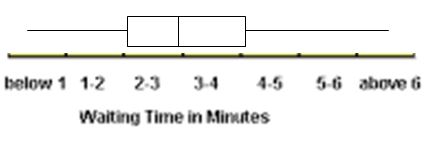
Here are two box & whisker plots (done in horizontal format, which I prefer):

box-plot-Wait_Times_May2016 box-plot-HDL_May2016


There are two basic flaws in the box & whisker display:

  1. The display implies information about variation, when the underlying summary does not (quartiles).
  2. The display requires the reader to invert the visual relationship:  A larger ‘box’ means a smaller density, a smaller ‘box’ means a larger density

Here are the underlying data sets, presented in histogram format (which is not perfect, but avoids both of those issues):

Histograma_HDL


histogram_wait_time


Some of the problems with box plots are well documented; a number of more sophisticated displays have been used.  See http://vita.had.co.nz/papers/boxplots.pdf. These better displays are seldom used, especially in introductory statistics courses.

The main attractions of the box-plot was that it provided an easy visual display of 5 numbers — minimum, first quartile, median, third quartile, maximum.  The problem with creating a visual display of such simple summary data is that it will always imply more information than existed in the summary.  We’ve got a solution at hand, much simpler than the alternatives used (which are based on maintaining the box concept):

Replace basic box-and-whisker plots with a “quartiled histogram”.

A quartiled histogram adds the quartile markers to a normal histogram display.  Here are two examples; compare these to the box plots above:

Quartiled-Historgram-HDL_May2016


Quartiled-Historgram-Wait_Times_May2016


The quartiled histogram combines the basic histogram with a simplified cumulative frequency chart — without losing the independent information of each category.

Perhaps a basic box and whisker plot works when the audience is sophisticated in understanding statistics (researchers, statisticians, etc).  Because of known perceptual weaknesses, I think we would be better served to either not cover box & whisker plots in intro classes — or to cover them briefly with a caution that they are to be avoided in favor of more sophisticated displays.

 Join Dev Math Revival on Facebook:

TPSE Math … Transforming Post Secondary Ed Mathematics

One of my Michigan colleagues recently reminded me of a national project on transforming post secondary education mathematics “TPSE Math”, which you can find at http://www.tpsemath.org/

This broad-based effort seeks to engage faculty and leadership from all segments of college mathematics, with an impressive leadership team.  I encourage you to check it out.

One of the first things I explored on their site deals with equity; they have a 2016 report on equity indicators (see http://www.pellinstitute.org/downloads/publications-Indicators_of_Higher_Education_Equity_in_the_US_2016_Historical_Trend_Report.pdf)  Interesting reading!

Another part of their web site I want to look at in more detail … “MAG” (Mathematics Advisory Group), which is focused on an ‘action oriented role’.  Take a look at http://www.tpsemath.org/mag

I’m expected that we will all be involved with this TPSE work, to varying degrees.

 
Join Dev Math Revival on Facebook:

Progression in Math — A Different Perspective

Much is made these days of the “7 percent problem” (sometimes 8%) — the percent of those placing in to the lowest math course who ever pass a college math course.  This progression ‘problem’ has fueled the pushes for big changes … including co-requisite remediation and/or the elimination of developmental mathematics.  The ‘problem’ is not as simple as these policy advocates suggest, and our job is to present a more complete picture of the real problem.

A policy brief was published in 2013 by folks at USC Rossier (Fong et al); it’s available at http://www.uscrossier.org/pullias/wp-content/uploads/2013/10/Different_View_Progression_Brief.pdf.  Their key finding is represented in this chart:

Progression alternate view USC Rossier 2013


The analysis here looks at actual student progression in a sequence, as opposed to overall counts of enrollment and passes.  This particular data is from California (more on that later), the Los Angeles City Colleges specifically.  Here is their methodology, using the arithmetic population as an example:

  1. Count those who place at a level: 15,106 place into Arithmetic
  2. In that group, count those who enroll in Arithmetic:  9255 enroll in Arithmetic (61%)
  3. Of those enrolled, count those who pass Arithmetic: 5961 pass Arithmetic (64%)
  4. Of those who pass Arithmetic, count those who enroll in Pre-Algebra: 4310 enroll in Pre-Algebra (72%)
  5. Of those who pass Arithmetic and enroll in Pre-Algebra, count those who pass Pre-Algebra: 3410 (79%)
  6. Compare this to those who place into Pre-Algebra: 68% of those placing in Pre-Algebra pass that course
  7. Of those who pass Arithmetic and then pass Pre-Algebra, count those who enroll in Elementary Algebra: 2833 enroll in Elementary Algebra (83%)
  8. Of those who pass Arithmetic, then pass Pre-Algebra, and enroll in Elementary Algebra, count those who pass Elementary Algebra: 2127 pass Elementary Algebra (75%)
  9. Compare this to those who place into Elementary Algebra: 70% of those placing into Elementary Algebra pass that course
  10. Of those who pass Arithmetic, then Pre-Algebra, and then Elementary Algebra, count those who enroll in Intermediate Algebra: 1393 enroll in Intermediate Algebra (65%)
  11. Of those who pass Arithmetic, then Pre-Algebra, and then Elementary Algebra, then enroll in Intermediate Algebra, count those who pass Intermediate Algebra: 1004 pass Intermediate Algebra (72%)
  12. Compare this to those who place directly into Intermediate Algebra: 73% of those placing into Intermediate Algebra pass that course

One point of this perspective is the comparisons … in each case, the progression is approximately equal, and sometimes favors those who came from the prior math course.  This is not the popular story line!

I would point out two things in addition to this data.  First, my own work on my institution’s data is not quite as positive as this; those ‘conditional probabilities’ show a disadvantage for the progression (especially at the pre-algebra to elementary algebra transition).  Second, the retention rates (from one course to the next) are in the magnitude that I expect; in my presentations on ‘exponential attrition’ I often estimate this retention rate as being approximately equal to the course pass rate … and that is what their study found.

One of the points that the authors make is that the traditional progression data tends to assume that all students need to complete intermediate algebra (and then take a college math course).  Even prior to our pathways work, this assumption was not warranted — in community colleges, students have many programs to choose from, and some of them either require no mathematics or basic stuff (pre-algebra or elementary algebra).

The traditional analysis, then, is flawed in a basic, fatal way — it does not reflect real student choices and requirements.  For the same data that produced the chart above, this is the traditional analysis (from their policy brief):

Progression traditional view USC Rossier 2013


This is what we might call a ‘non-trivial difference in analysis’!  One methodology makes developmental mathematics look like a cemetery where student dreams go to die; the other makes it look like students will succeed as long as they don’t give up.   One says “Stop hurting students!!” while the other says “How can we make this even better?”

So, I’ve got to talk about the “California” comment earlier.  The policy brief reports that the math requirement changed for associate degrees, in California, during the period of their study: it started as elementary algebra, and was changed to intermediate algebra.  I don’t know if this is accurate — it fits some things I find online but conflicts with a few.  I do know that this requirement is not that appropriate (nor was elementary algebra) — these are variations of high school courses, and should not be used as a general education requirement in college.  We can do better than this.

This alternate view of progression does nothing to minimize the penalties of a long sequence.  A three-course-sequence has a penalty of about 60% — we lose 60% of the students at the retention points between courses.  That is an unacceptable penalty; the New Life project provides a solution with Mathematical Literacy replacing both pre-algebra and elementary algebra (with no arithmetic either) and Algebraic Literacy replacing intermediate algebra (and also allowing about half of ‘elementary algebra students’ to start a course higher).

Let’s work on that question: “How can we make this even better?”

 Join Dev Math Revival on Facebook:

WordPress Themes