FOIL in a Box (algebra!)
Some of us have a ‘thing’ about FOIL as a topic in an algebra class; there are concerns about emphasizing the FOIL process as it can submerge the real algebra going on. Some (perhaps the majority) are not significantly handicapped by being “FOILed”. This post is not about FOIL itself … it’s “FOIL in a Box”.
Okay, so this is what I am talking about. The problem given to the student is to multiply two binomials, such as (2x – 3) and (3x +4). Here is the “FOIL in a Box”: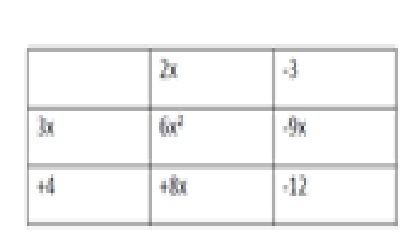
Some students like this approach, and I think this is because the box lets them focus on one small part of the problem. The overall process is submerged, and the format does all of the work. Of course, this is exactly what many procedures in arithmetic do. The FOIL in a Box method is much like column multiplication, where partial products are arranged in a mechanical way to produce the correct place value. If correct answers to multiplying were the primary goal, there would be nothing wrong with either FOIL in a Box or partial products in arithmetic.
My observation has been that almost all students who use FOIL in a Box are handicapped in working with polynomials. Students have trouble integrating the Box into longer problems. And, though they may have some ‘right answers’ for factoring trinomials, the transition to other types is more difficult.
What should we do instead? My own conclusion is that we need to keep emphasizing the entire idea involved. FOIL is used for “distributing when both factors have two terms”, and “distributing is used to multiply when one factor has two or more terms”. We too often assume that students will keep information connected to the correct context … they don’t automatically know that distributing does not apply to 3 monomial factors [3(2y)4z ≠72yz], nor to a power of a binomial [(x + 3)² ≠x² + 9].
The achievement of correct answers in the short-term should not come at the price of handicapping the student’s future learning. All learning should be connected to good prior learning, and imbedded within the basic ideas of the discipline. We need to be comfortable articulating the full name of what we are doing (multiplying two factors each with two terms), and not use a mnemonic such as FOIL as a container for knowledge of mathematics.
Join Dev Math Revival on Facebook:
 Content of developmental math courses, Learning math, Uncategorized | Jack Rotman |
  February 10, 2012 8:58 am |
  Comments (3)

 Subscribe
 Jack Rotman
NOTE: This blog will become 'inactive' on January 1, 2020.
Jack Rotman
NOTE: This blog will become 'inactive' on January 1, 2020.