Neat Knowledge? Messy Landscape?

We all spend quite a bit of time talking with students, and we also look at massive amounts of student work.  Sometimes, we get in to “homework system mode” where we only provide feedback on the answer.  The answer, by itself, is very weak as a communicator of the knowledge a student possesses. 

I have been thinking about how messy student knowledge is (about mathematics); perhaps this is true for all domains.  In my classes, I try to create an atmosphere where people feel safe asking questions and participating; of course, sometimes the questions asked indicate significant misunderstandings … which can temporarily cause some damage to the overall learning in the class.  In this post, I want to focus more on the implications of errors in student work.

Okay, in our intermediate algebra class we just had a test on ‘quadratics’.  The material is a mixture of procedural and conceptual, with a few ‘applications’ included.  One of the applications involves compound interest (annual) for 2 years — so it creates a quadratic equation like this:
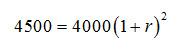
 Most students managed to write this (based on the verbal description and the provided formula).  The most common error?  Subtracting 4000 from each side, a disturbing error.  Since this problem was on a test, I did not have an oppportunity to discuss the error with the students to identify the source.  My primary suspect:  An early rule (early in education) to the effect that “large and small numbers mean divide, similar size numbers mean subtract”.  Every  one of these students can solve linear equations requiring division (like -4x=30), and most solved a quadratic involving a common factor (like 2x²=100).  What triggers  the “we must subtract” response?

In another class (the quantitative reasoning course), we have been doing geometry this week.  As for other topics, the formulas are provided — we are much more interested in the reasoning involved.  One of the problems dealt with finding the perimeter of this shape:

Two consistent problems came up.  First, students thought that ALL perimeter problems dealt with “P = 2L + 2W” … causing them to count the widths of the rectangle (which are interior, therefore not part of ‘perimeter’).  Second, even when convinced that some perimeter problems dealt with a different relationship, they did not see  why we should omit the perimeter (they still wanted to include the interior dimension).  Since I was able to discuss these issues, I have some idea of what is behind them. 

My point here is not to complain about what students do or don’t do, nor to suggest that they have had bad teaching  [I mean, beyond having ME as a teacher :)].  Rather, perhaps we need to think more about the root cause for many student difficulties: 

The basic problem is an oversimplification of a connected set of ideas down to a single ‘if-then’ clause.

Students are sometimes desperate to learn math, and we want to help them.  Too often, this results in only dealing with one thing (or one thing at a time) — which simplifies the learning, but which avoids building connections (contrast, similar).    The geometry instance of this is easily described:  by only dealing with one shape for ‘perimeter’ we encourage students to connect just one formula with that work — and to disconnect this from the concept involved (‘distance around’).   Our procedural work in algebra is even more prone to the oversimplification, because the correct learning is abstract about a combination of ‘properties’, ‘undoing’, and ‘maintaining value OR balance’. 

I’ve got to anticipate what some readers are thinking (due to that last sentence) … are manipulatives the solution for this problem in algebra?  Not really.  The research I have read on ‘kinetic learning’ suggests that this might provide some of the scaffolding to abstract ideas — but is counter-productive if the manipulative remains a focus.  This is a very difficult task, to shift from manipulative to concept; the stages vary with each learner.  If you can do manipulatives on an individual basis with continual feedback (conversation) with a highly skilled faculty, then I believe this can support better learning.   The skills involved are complex, and most faculty will not have them — including me; this is combining the skills of a cognitive researcher, qualitative researcher, and math faculty.  The problem with most manipulatives in learning is that the entire process is over-simplified to be practical in a group setting; a group of 3 students is too large, and possible 2 students is too large.

What is the answer?  We need to clearly articulate the few critically important learning outcomes in a math class (perhaps a dozen for a course), and provide diverse learning experiences around those outcomes.  “Simple” is not the solution; simple is part of the problem.  The solution is a planned sequence of activities to deeply explore the ‘good stuff’ of mathematics.

 
Join Dev Math Revival on Facebook:

Slope … Fast?

Well, I’ve been somewhat discouraged by the latest test in our ‘math – applications for living’ course.  This test is all about understanding linear (additive) and exponential (multiplicative) change.  In spite of approaching these models in different ways, followed up by repeated work, students had considerable difficulty translating verbal descriptions to anything quantitative or symbolic.

One basic problem seems to be that students did not start with much understanding of slope for linear functions.  Every student in the class had completed beginning algebra (usually recently), where we do the usual work with slope — calculating it, using slope to graph, and finding the equation of a line given information about slope.  When faced with non-standard problems with information on slope, the transition to quantitative or symbolic statements was not easy.

One part of this difficulty is the connection between input  & output units and units in slope.  Like most traditional algebra books, ours does not make an issue out of units for slope in ‘applications’; as you know, slope must involve two units.  Because of this difficulty, students would see a percent change as a linear change.

Mostly, this post is a “note to self”:  Learning slope is not really a fast thing.  Repeated use, alternate wordings, and non-standard problems need to be used to build a more complete understanding.  We too often spend a week or two on all linear function topics in a beginning algebra course; to get that ‘sufficiently good’ understanding, we need to allow more time so we can really dig in to what slope and the linear form are doing.

Join Dev Math Revival on Facebook:

Treisman & Rotman Webinar – June 6 (AMATYC)

Uri Treisman and I have been involved with efforts to systematically reform developmental mathematics, such as New Life, Carnegie Pathways, and the Dana Center New Mathways.  Uri has been very supportive of our AMATYC work, including the New Life project.

On June 6 (4pm Eastern), we will be doing a joint Webinar on Issues in Implementing Reform in Developmental and Gateway Mathematics as part of the AMATYC webinar series.  The goals of this webinar are to present some general concepts to guide our work in reform, and to share some practical means to implement those concepts.

Here is the way the AMATYC webinars work — AMATYC members can register for a webinar (at http://www.amatyc.org/publications/webinars/index.html).  Registration usually begins about two weeks before the event (so you won’t see this one listed in April!).  AMATYC members who register will receive an email with directions (the day before the webinar). 

One thing to point out — people can watch the webinar as a group!  One person needs to be an AMATYC member and register; you can include non-members in the viewing process.  (The directions you receive will even tell you how to make the group process work better.)

I hope you can join us for this webinar.

Join Dev Math Revival on Facebook:

Math on the Other Side

A recent post here dealt with the metaphor of developmental mathematics as a bridge, designed to help students reach the other side.  The ‘other side’ is not just mathematics (would we really want that?), with a diverse collection of courses … some of which are called ‘gateway courses’, while others are ‘just’ college courses.  So, the question today is “What about the math on the other side”?

Is the math ‘on the other side’ the good stuff (important mathematics)?  Do courses ‘on the other side’ place a high priority on student success?  If we reform developmental mathematics in to a program which makes a difference in the mathematical learning of students, will their ‘college math courses’ have the same vitality?

These are questions which I can not answer; I am not immersed in the world of college-credit math classes (just parts of it).  However, I do know that our profession is rather silent on this component of our curriculum … we are talking a great deal about developmental mathematics, and I hear quite a bit about STEM and calculus.  Not so much about college algebra … pre-calculus … liberal arts math … or math for elementary education majors.

The easy target in this list is college algebra.  Pre-calculus … at least we know what the goal is (calculus), and students taking pre-calculus can be assumed to have that goal (even if incorrectly assumed).  However, we have absolutely no agreement on what ‘college algebra’ is.  For some of us, college algebra is what we happen to call our pre-calculus course; for this group, I would say “Hey, be honest … call if pre-calculus!”   For others, college algebra is actually a prerequisite to pre-calculus; on this … “how much time is needed getting ready for calculus?”  [Perhaps we place additional steps in between to make sure that only the best survive; I hope not.]  For still others, college algebra is a course outside of the pre-calculus sequence, perhaps used as a preparation for symbolic-based science courses; this is a good reason to have a course … though I question whether ‘algebra’ is the majority of what the students need.  Some use ‘college algebra’ as a general education course; I suggest to you that a course could be either college algebra OR general education … but not both.  One of the problems with the ‘college algebra’ label is that the traditional developmental math courses generally have ‘algebra’ in the titles; is ‘college algebra’ more of that developmental stuff?

Perhaps my worries here are just due to my extensive ignorance of some aspects of our curriculum.  Perhaps, outside of the college algebra mess … perhaps we have generally sound mathematics and important ideas in our curriculum.   Perhaps my problem is that I look at textbooks.  If most of my colleagues who specialize in these courses tell me that ‘things are okay’ on the other side, I would certainly be relieved.  However, with all of the current focus on developmental mathematics, it is possible that we are ignoring something equally important.

In our bridge metaphor, are we working on improving the bridge … just so that students can be delivered to a great wasteland of college mathematics on ‘the other side’?

Join Dev Math Revival on Facebook:

WordPress Themes