One of the issues our department is looking at is the course prior to beginning algebra … we call it Pre-Algebra. The current incarnation of this course includes early work with variables, expressions and equations — based on the thought that this will help prepare students for algebra. The results are not what we would hope for.
Is “Pre-Algebra” an oxymoron? The word oxymoron (apparently) literally means “sharp dull”, and the implication of the word is that the two concepts are contradictory. What really comes before algebra (‘pre’)??
I’ve commented previously that arithmetic, as an academic topic, is more difficult than algebra and therefore it is illogical to use arithmetic as a prerequisite to algebra. If we look at ‘tests’ of readiness for algebra (a typical one is http://www.algebra-class.com/algebra-readiness-test.html) the content is a mixture of arithmetic of whole numbers and fractions, order of operations, ‘simple’ algebraic expressions and equations, and perhaps some basic geometry knowledge. Our own pre-algebra course looks a lot like this.
What does a real student take away from (gain from) this pre-algebra experience? Here is a (somewhat cynical) summary:
- Whole numbers — “Okay, got that; thanks for making me go through this for the 20th time”
- Fractions — “Are we done with those yet? I hope you don’t expect me to remember this; I certainly do not understand fractions.”
- Order of operations — “Look for parentheses; there is also something about multiplying before adding, I just have trouble remembering what it is.”
- Algebraic expressions — “I don’t get why x and y are different … they are both unknown; I remembered the rule for simplifying until I took the test … not a minute longer.”
- Basic equations — “I like finding x; just don’t give me a word problem. Oh, and I prefer to not show steps for solving … is that okay?”
- Basic geometry — “Don’t give me too many formulas to memorize; I can do the geometry. What’s the deal with area having a different unit than perimeter?”
Like many of us and our courses, our course is mostly about using procedures to get correct answers … and this shows in what students get out of the class, and painfully shows when the students take an algebra course. Some parts of a typical beginning algebra course can be done by simple procedures; some topics are ‘procedure challenged’ (like graphing, and systems). If the list above is an accurate summary of what a student gains from pre-algebra, then it has nothing to do with being ready for algebra … pre-algebra has become an oxymoron.
Once upon a time, pre-algebra did not exist. We offered some arithmetic courses, and sometimes used arithmetic as a prerequisite to algebra (reinforcing the myth that all mathematics is a linear and dependent sequence of steps). Some pre-algebra courses are really arithmetic courses with a less remedial name; some are an honest attempt at improving readiness for algebra. Is there ANY evidence that a prerequisite to algebra exists in a form that could be the basis for a course?
Some research has been done, mostly at the middle school level. For example: http://www.mheresearch.com/assets/products/ea5d2f1c4608232e/CA_Algebra_Readiness_Research_Base.pdf and http://www.rachaelwelder.com/files/vitae/Welder_Prereq_Know_Algebra.pdf . The research cited by such articles is often descriptive in nature, which can show (at best) some correlation. [The latter reference even includes a 1991 presentation I made at an AMATYC conference! That report might be helpful, in spite of that.]
Some middle school programs might do a better job of algebra readiness than colleges; we, in the college setting, generally do a procedural course with little designed to help students mature their thinking and reasoning. I do not have a definite answer … I can not say “THIS stuff is the real prerequisite to algebra!” However, I can tell you that having a student generate 2000 correct answers to a variety of problems has nothing to do with being ready for algebra. We might be better off using a general test of reasoning as the prerequisite (ie, active writing skills … as opposed to reading).
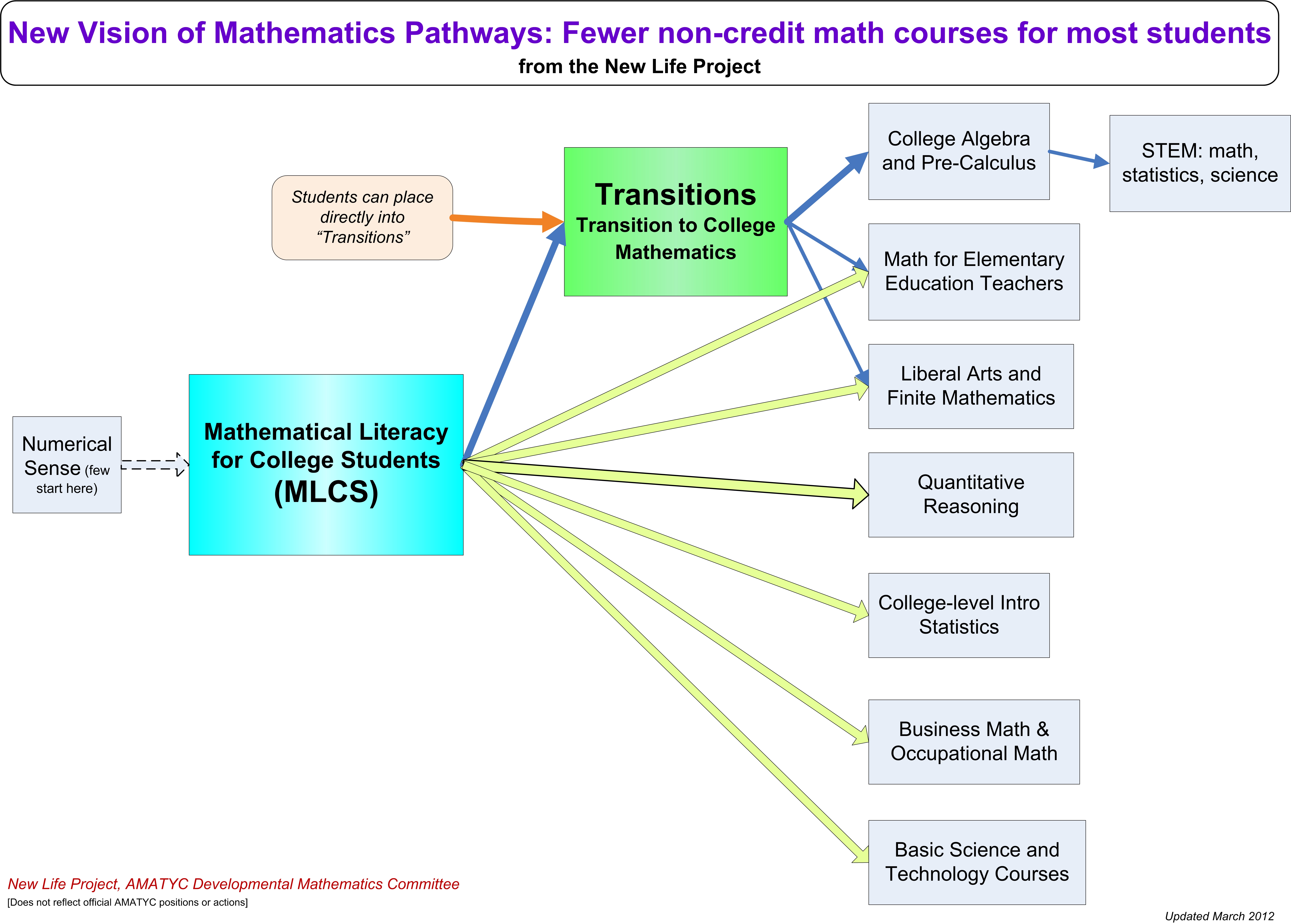
In the New Life model, we do not have a pre-algebra course or level. The first course, Mathematical Literacy for College Students (MLCS), stands mostly on its own. The people involved in designing MLCS have identified some prerequisites to MLCS — which fall in the category of ‘basic numeracy’. Here is that list:
-
Use arithmetic operations to represent real-world operations, such as putting together, comparing, distributing equally, etc.
-
use real-number arithmetic to solve stated problems.
-
Use graphical representations on a number line to demonstrate fluency in
-
interpreting interval notation,
-
ordering numbers,
-
representing operations (i.e., addition, subtraction, doubling, halving, and averaging)
- representing decimal numbers, including negative numbers.
This list was created by ‘backwards analysis’ — looking at the learning in MLCS, what specifically does a student need to know before then? This list is quite short, and our dream is that students who need this content can be served WITHOUT taking another course — whether this is done via a boot-camp review, or ‘just in time remediation’ within MLCS. [The list is from https://dm-live.wikispaces.com/file/view/MLCS_Numeracy_March2010.pdf]
It is possible … really possible … that we could start students directly in MLCS (or the beginning algebra) without a prerequisite; a little bit of support on prerequisite knowledge, and some scaffolding within MLCS or algebra, would be enough for almost all students.
Join Dev Math Revival on Facebook:
 Math curriculum in general, Professional Development | Jack Rotman |
  April 2, 2012 12:53 pm |
  Comments (0)
 Subscribe
 Jack Rotman
NOTE: This blog will become 'inactive' on January 1, 2020.
Jack Rotman
NOTE: This blog will become 'inactive' on January 1, 2020.