Category: Math curriculum in general

Sticky Math

In the world of web design, there is a concept called ‘sticky web pages’ or ‘sticky content’ … the concept being that a design can encourage people to click on links and/or return to the page.  [A brief explanation at http://en.wikipedia.org/wiki/Sticky_content, and some tips at http://techtips.salon.com/sticky-pages-10404.html.]

If you are changing your developmental math program … are you creating ‘sticky math’?  Are students motivated by the design to spend more time than required?  Are students inspired to take more math than is required?

I can hear the cynics among us thinking ‘That is just not reasonable — students just will not do more math than required’.  Well, this is not a question of past evidence … this is a question of the over-arching goals of a math curriculum.  Are we providing the absolute shortest (and presumed negative or neutral) experience with mathematics … or do we seek to provide appropriate mathematics in an attractive manner that inspires students to be more mathematical?

I have been thinking about this concept for quite a while.  Historically, developmental mathematics has been an overly long series of courses to prepare students for the ‘good stuff’ (calculus, in that paradigm).  Some of the current redesign efforts have a deliberate goal of getting students out of mathematics as quickly as possible — often via a set of modules, of which most students need a proper subset.   This “quick out” approach is an understandable reaction to the old courses, and has appeal to people outside of mathematics (like administrators and policy makers).  Most “modularized developmental mathematics redesigns” are based on a quick out for students.

We can do better than a “quick out” methodology.  A common theme of the emerging models for developmental mathematics — New Life, Carnegie Pathways, and Dana Center Mathways — is students are capable of learning sound mathematical concepts presenting in an engaging fashion, which will result in some students being inspired.  Some students will be inspired to work harder on one course or just parts of it; other students will be inspired to consider taking additional mathematics.

Reasoning about quantities, core ideas about proportionality, key ideas of algebraic reasoning, and concepts of functions are components of ‘sticky math’.  Even some traditional polynomial algebra can be ‘sticky’, though not when presented as a series of procedural skills disconnected from broad ideas.  However … the most fundamental ingredient for ‘sticky math’ is the faculty students work with.   Technology has strengths and a role to play; by itself, technology is not enough.

However you redesign or reform your developmental mathematics courses, I encourage you to create sticky math experiences for all of your students.  Provide the ‘good stuff” (important mathematics) with faculty deeply engaged with the learning environment.  Inspire your students!

Join Dev Math Revival on Facebook:


Building a New Developmental Math Curriculum

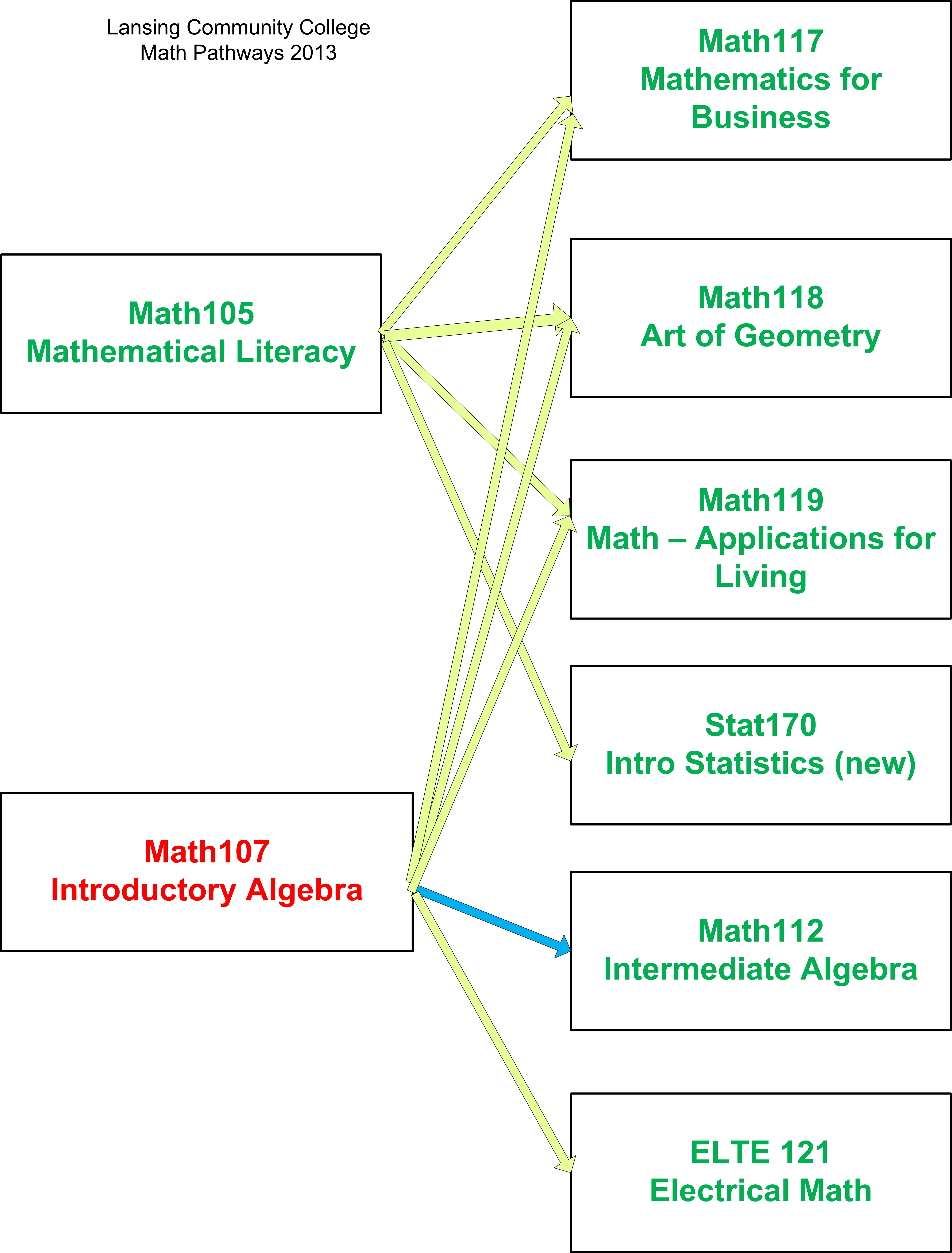
You may have been wondering whether anybody is ‘making this  real’ when people talk about basic change in developmental mathematics.  Here at Lansing Community College (MI), we have been working on building pathways for students.  Beginning in 2013, we are offering a new course — Math105, Mathematical Literacy based on the MLCS course (New Life).  Math105 will be a prerequisite for 3 of our existing general education math courses.

Connected with this, we planning on a second introductory statistics course which can use this Math105 as a prerequisite.  As a result, students will be able to move from Math105 to one of 4 destination courses — all meeting a degree requirement.  Our beginning algebra course (Math107) will continue to meet the prerequisite for these 4 destination courses, as well as intermediate algebra. 

Here is an image of our math pathways, effective 2013:

NOTES: The prerequisite to Math105 and Math107 is the same (‘pre-algebra’).  We also have another pathway for ‘Tech Math’ (Math114 and 115), which is stands apart from this image (in general); we make exceptions for some students who change programs after starting Tech Math.

So, here is the main point of this post:  Most of us have math courses that are outside of the beginning algebra to college algebra route, such as business math (Math117 at LCC) or quantitative reasoning (Math119 at LCC) … you can implement a course like MLCS (mathematical literacy for college students) to use as a prerequisite for these other courses.  Some of us are still using arithmetic or pre-algebra as the prerequisite for such courses, and you may find that those prerequisites do not meet the needs very well … and MLCS could be an excellent match. 

We at LCC are enthusiastic about building better math pathways for our students, and we hope you will join us in this work.

 
Join Dev Math Revival on Facebook:

Mathways Webinar – Video available (April 17 webinar)

The Dana Center (University of Texas – Austin) hosted an excellent webinar on April 17.  If you would like to see the video of the webinar, use this link:

https://danacenter.webex.com/danacenter/lsr.php?AT=pb&SP=EC&rID=5109287&rKey=d960ab9030d6c9f9

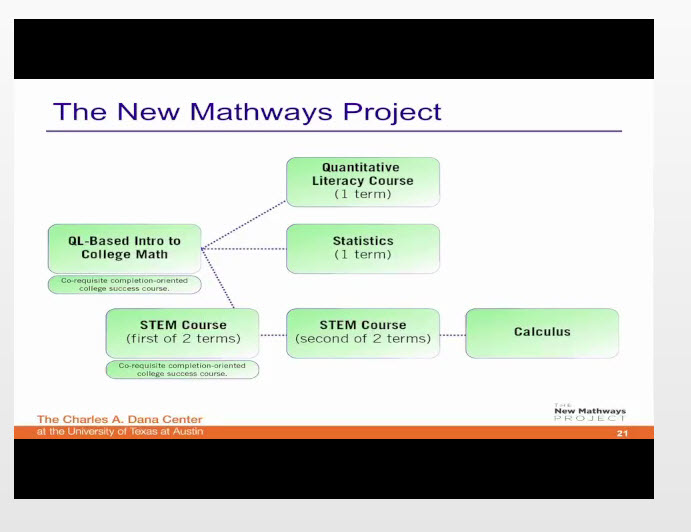
One part of the webinar shows this image of the curriculum structure:


I can see some encouraging similarities between this visual and the New Life model; our work in New Life will be very consistent with the work of the Dana Center.

 
Join Dev Math Revival on Facebook:

Rotman’s Race to the Top

A few year’s ago, Paul Lockhart wrote an essay entitled “A Mathematician’s Lament”, sometimes known as “Lockhart’s Lament”.  I find this essay to be incredibly inspiring.

If you have not read it, here is a copy: lockhartslament

As far as I know, Lockhart never published this essay. I actually know very little about Paul Lockhart, besides the information that he went to teaching in a K-12 school after being a university professor for a time.  Some brief bio stuff is at http://www.maa.org/devlin/devlin_03_08.html

Okay, back to the essay.  Paul Lockhart is presenting a vision of mathematics as an art, not as a science, where learning is very personal and where inspiration is a basic component.  A fundamental process in Lockhart’s vision is the personal need to understand ideas, often ideas separate from reality.  The ‘lament’ aspect of the title for the article refers to the view that school mathematics has made mathematics into ‘paint by numbers’ instead of an exciting personal adventure.  Where we might focus on insight and creativity, we instead deliver an assembly line where students receive upgrade modules to their skill sets; Lockhart presents the view that these skill sets have nothing to do with mathematics.

I have two reasons for highly appreciating this essay.  First of all, people often assume that I believe that mathematics should be presented in contexts that students can relate to (probably because I advocate for “appropriate mathematics”).  Contexts are fun, and we can develop mathematics from context.  However, contexts tend to hide mathematics because they are so complicated; mathematics is an attempt to simplify measurement of reality, so complications are ‘the wrong direction’.  When I speak about appropriate mathematics, I am describing basic mathematical concepts and relationships which reflect an uncluttered view of mathematics; applicability might be now, might be later … or may never come for a given student.  Education is not about situations that students can understand at the time; education is about building the capacities to understand more situations in the future.

The second reason for appreciating Lockhart’s Lament is the immediate usefulness in teaching.  If we believe that students want to understand, then we can engage them with us in exploring ideas and reaching a deeper understanding.  Here is an example … in my intermediate algebra class this week, we introduced complex numbers starting with the ‘imaginary unit’.  Often, we would start this by pointing out that ‘the square root of a negative number is not a real number’ and then saying “the imaginary unit i resolves this problem.”

Think about this way of developing the idea instead (and it worked beautifully in class). 

  1. Squaring any real number results in a positive … double check student’s understanding (because quite a few believe that this is not true).
  2. The real numbers constitute the real number line, where squaring a number results in a positive.
  3. Think of (‘imagine”) a different number line where squaring a number results in a negative.  Perhaps this line is perpendicular to the real number line.
  4. We need to tell which number line a given number is on; how about ‘i‘ to label the number?
  5. Let’s square an imaginary number and it’s opposite (like 2i and -2i).
  6. Squaring an imaginary number produces ; since the imaginary numbers are those we square to get a negative, must be -1

Any context involving imaginary or complex numbers is well beyond anything my students would understand.  I would always want to explore imaginary numbers; first, it provides a situation to further understand real numbers … second, the reasoning behind imaginary numbers is accessible to pretty much all students.

You might be wondering why I gave this post the title “Rotman’s Race to the Top”.  One reason is just not very important … I wanted a alliteration comparable to “Lockhart’s Lament”; well, I tried :).  The important reason is this:  The “Race to the Top” process is based on  some questionable components that do not connect directly with the learning process (common standards [a redundant phrase], standardized testing, and outcomes.  The world we live in, as teachers of mathematics, is a personal one: We interact with our students, we create situations that encourage learning, and we want our students to value learning for its own sake.  We also want our students to understand some mathematics.  Inspiration and reasoning have a lot more to do with this environment than any law or governmental policy.

Rotman’s Race to the Top is the process of teachers showing our enthusiasm, modeling the excitement of understanding ideas, and helping each student reach a higher level of functioning.  Building capacity and a maintaining a love for learning are our goals.  Rotman’s Race to the Top is about our students and their future.

Will you join this Race to the Top?

 
Join Dev Math Revival on Facebook:

WordPress Themes