Category: Math curriculum in general

Reform Models in Developmental Mathematics

For many years, our developmental mathematics programs were based on a remedial image — filling in the ‘swiss cheese’ of student’s knowledge of school mathematics, with the school mathematics based on an archaic content (circa 1965).  Now, for the first time, we have an opportunity to explore a model of developmental mathematics that is based on mathematical needs of students — designed especially for community colleges.

During the June 6 (2012) webinar, Uri Treisman presented some general concepts to guide our work in reforming our curriculum; my component of the webinar dealt with applying these concepts in our departments.  In this post, I want to share two possible structures for reform of developmental mathematics as presented that day.  [The recording of the webinar will be available later this summer.]

One approach to reform is to target reform for particular groups of students.  You might identify students who need an intro statistics course, or those who need a quantitative reasoning course, and design a prerequisite course just for these students.  In this approach, the existing developmental mathematics curriculum is left undisturbed … at least for now.  The resulting curricular model looks something like this:
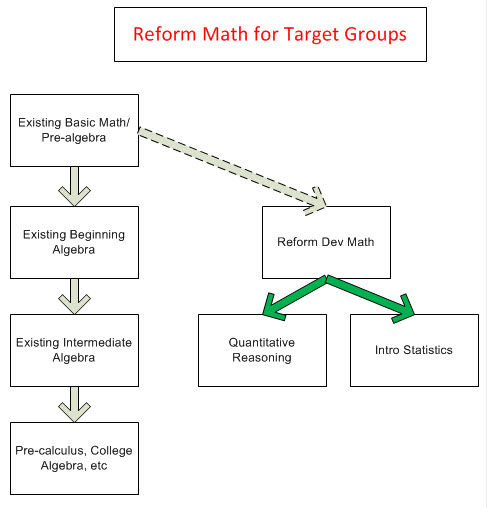
This ‘targetted’ approach is reflected in the Statway and Quantway work, for example.  However, this is not the only … nor necessarily best … approach.  Since our content is heavily influenced by archaic high school content, the mathematical needs of students — especially in reasoning and transfer of learning — would be better served by a total reform.

A reform for all students (total reform) has a goal of replacing existing courses.  In this model, the beginning algebra course is replaced by mathematical literacy course (which is also part of the target reform model); the intermediate algebra course is replaced by a reform algebra course … which some students would not have to take to meet their math needs. 

This reform for all students model creates this visual:


The reform algebra course (“B” in this visual) might be the one described as “Transitions” in the New Life model; see http://dm-live.wikispaces.com/TransitionsCourse.  Some colleges might consider a combined beginning & intermediate algebra course for course B; this is not a reform course (as the content is the traditional … and archaic … material).  Another option in this total reform model is to create a faster path in pre-calculus — blend ‘course B’ (reform algebra) and pre-calculus in to a 2 semester sequence for those students. 

Reform in developmental mathematics is needed.  However, reform in developmental mathematics is not sufficient; we also need to reform the introductory college mathematics courses to reflect current needs and professional knowledge.  Our students deserve the best mathematics we can provide, both in developmental and college-level courses.

 
Join Dev Math Revival on Facebook:

Editing Math: Writing as a Guide to Better Mathematics Learning

I was talking to a colleague who teaches writing about the placement test, wondering if the test they happen to use gives them results that seem valid for getting students in to the best course.  As we were talking, I wondered … could we learn from the writing placement tests and writing courses about how to help our students?

The writing placement test we were talking about is one of the very common instruments used to place students at community colleges.  The test contains a series of writing samples (one at a time); students need to identify sentences with errors, and then also answer a question or two about the writing.  When I asked my colleague about how well this worked, he said that it primarily just tested editing skills as opposed to writing skills.

Would math learning be improved if we held ‘editing’ in higher esteem?  Would students become more able to think in mathematical terms if they routinely examined their mathematical writing?  Should our math placement tests involve the process of students editing mathematical work to identify either strategic or tactical errors?

Like many of us, I routinely tell my students to check their work for errors.  Competing with this ‘proofreading’ direction is the type of ‘check’ suggested in most textbooks (put it back in).  The concept of editing applies to mathematical work, which we practice when we develop handouts and other materials for our students.

In developmental mathematics, a portion of our population are not yet ‘college level’ in their writing; students are challenged to write clear sentences and paragraphs … and challenged to write clear mathematical steps and solutions.  Writing is the most direct measure of the knowledge held by the student, which is a tool for the student to look for gaps and confusions.   Perhaps editing this work is a step along the path towards more developed metacognitive skills.

I would like to try this concept in my classes: Editing mathematics as a learning tool.

Separate from the classroom use, I wonder — should math placement tests involve different processes other than “get the answer”?  Would we get better measures of readiness if students needed to examine a few steps of mathematical work to identify errors? 

 
Join Dev Math Revival on Facebook:

Reform Efforts in Developmental and Gateway Math Courses

Are you looking for a ‘one-stop’ summary of reform efforts?  Perhaps you have been told you need to do a redesign, and wonder if there is a better alternative.  Maybe you have been teaching in a redesigned curriculum with intense use of technology, and are looking for something that works  better for your students.  The purpose of this post is to provide a quick summary of some national efforts and a few state-based efforts.  [Some of this was shared at the end of the June 6, 2012, webinar on reform in developmental and gateway math courses.]

New Life Project  (AMATYC Developmental Mathematics Committee) — project information at http://dm-live.wikispaces.com

The New Life Project developed a general curricular model to replace the traditional developmental mathematics courses, based on applying the work of prior professional work (such as MAA, NADE, Numeracy Network, and others) with a goal of fundamental change not only in the curriculum but in the profession.  The work is fundamentally based on the more progressive ideas in the AMATYC Standards ( Beyond Crossroads, http://beyondcrossroads.amatyc.org/).  Colleges and faculty implementing the New Life work adapt the general model to their specific local needs and resources; no grant money is involved with the project.  The New Life model can be used for targeted groups, or for all students.

Dana Center New Mathways Project — information at http://www.utdanacenter.org/mathways/

The New Mathways Project is an evolution of the Statway™ and Quantway™ work, which was a shared development by the Carnegie Foundation (see below) and the Dana Center (University of Texas – Austin).  The Dana Center used additional faculty and college input to elaborate a model for 3 basic paths — Statistics, Quantitative Literacy, and STEM, each sharing a new Student Success course.  The New Mathways Project includes development of all instructional materials, which is about to begin.  The project web site has a very useful implementation guide which will help any reform effort.

Carnegie Foundation Pathways (Statway™, Quantway™) — information at http://www.carnegiefoundation.org/pathways-connection

The Pathways Project was begun in 2009, which parallels the work of the New Life Project; the initial math learning outcomes for the pathways came from the New Life work, and several people were involved with both efforts.  Currently, the Pathways are “closed systems” — access to the curricular materials and homework system is limited to colleges which are members of the “Networked Improvement Community” (NIC); members of the NIC work together to implement a generally uniform curriculum.  The Pathways implementations are limited to targeted groups of students — those who need a statistics course or those who need a quantitative reasoning course.  The development of the Pathways was grant funded; colleges joining at this stage will be paying modest fees to support the work of the NIC.

AMATYC Right Stuff for college algebra — information at http://www.therightstuff.amatyc.org/

The Right Stuff project developed alternative lessons for a college algebra course used for general education, with NSF funding.  A strength of this effort is the concrete modules that instructors can implement; the project also has a web page of other resources for college algebra (see http://www.therightstuff.amatyc.org/resources/).  At this time, there is no known effort at the national level to broadly change the college algebra courses … though MAA has issued a number of reports and calls for change.

State effort — FOCUS (Texas State University ) — information at http://www.math.txstate.edu/devmath/FOCUS.html

State effort – CAP (California Acceleration project) — information at http://cap.3csn.org/

State effort — RPM (Rethinking Precollege Mathematics, Washington) — information at http://rethinking-precollege-math.wikispaces.com/


If you are aware of other efforts (national in particular, or especially in college algebra  & gateway courses), please let me know!

 
Join Dev Math Revival on Facebook:


Hope, Vision, and Developmental Mathematics: Moving towards a Mathematical Literacy Approach

This year has seen a number of reports and articles with very strong negative statements about developmental or remedial mathematics.  As an example, Complete College America issued a report calling remediation a ‘bridge to nowhere’ (see http://www.completecollege.org/docs/CCA-Remediation-final.pdf).  A quick online search will produce many citations of this report; other reports and articles have been published. 

Is there hope for developmental mathematics?  Do we have a role to play in the upward mobility within American society?

If we conceptualize developmental mathematics as basic skills or as ensuring that all students have ‘the math they should have had in high school’, then the answer is probably no to both questions.  These approaches describe a remedial mathematics program.  Since many people see ‘developmental’ as a polite descriptor for remedial, perhaps we should begin to advocate a shift towards mathematical literacy as a framework for our work in colleges.

Policy makers look at the results of our programs and conclude that the investments are not appropriate.  Legislatures see the credits used for remedial or developmental mathematics as an inappropriate redundant expense — they have already paid for students to do this work in the K-12 system.   Researchers find that completion of remedial or developmental mathematics courses is not strongly connected with success in college.  States consider banning developmental or remedial mathematics (or all developmental courses).

I suggest that we can, in fact, drop our traditional developmental and remedial math programs as they are currently designed.  These programs are historical artifacts, dating from an era when colleges and universities held different standards for entering students:  College students had to have been good high school students, therefore students who could not show current knowledge of school mathematics had to complete ‘remedial’ courses.

I suggest that we focus on mathematical literacy as a framework for getting students ready for college work.  A mathematical literacy framework means that we do not fixate on the high school math curriculum; rather, we directly deal with the mathematics needed in college.  Instead of 200 ‘basic skills’ in a remedial program, a mathematical literacy program would have a small set of important mathematical concepts and tools — proportionality, growth and decay, representations, numerical methods, basic symbolic methods.

A mathematical literacy program has the promise of a closer integration of mathematical preparation with other college work.  Most college courses do not deal with dozens of discrete skills with few connections to each other; most college courses focus on a smaller number of big ideas, with a focus on understanding and application.  Students who experience a mathematical literacy preparation will have a shorter bridge to cross in order to reach the demands of other courses.  A mathematical literacy program offers the promise that students will be inspired to learn more mathematics, instead of looking for the earliest exit ramp.

The emerging models of developmental mathematics are steps in this direction, although they sometimes allow the traditional developmental math program to continue.  Our long-term goals should include providing a more powerful experience for all students, not just those in select programs.  Whether it takes 5 years or 10 years, let us work towards the goal of replacing an antiquated remedial math model with a functional mathematical literacy model.

Especially in community colleges, enabling upward social mobility is part of our core purpose.  Far too often, our current model prevents students from achieving this upward mobility due to too-low pass rates and too-low completions of a sequence.  We can … and must … do better.  The vision of a mathematical literacy approach offers hope for us and the students who depend upon us.
Join Dev Math Revival on Facebook:

WordPress Themes