Category: Math curriculum in general

Mythical Course Holds Key for Reforming Mathematics

The concern is not that “those who ignore history are bound to repeat it”.  No, the concern is that those who ignore history create conditions that hurt students.  In the case of mathematics, the mythical course called intermediate algebra holds the key for reforming mathematics … and policy makers often fall in to self-defeating behavior because they ignore history.

Here is the core question:

Is it possible for a course to be ‘college level mathematics’ if it does not have an intermediate algebra prerequisite?

In an opinion (Sacramento Bee), Katie Hern writes of the challenges facing the dozens of California community colleges who have implemented an alternative statistics pathway (http://www.sacbee.com/2012/11/10/4974786/new-approach-to-remedial-math.html).  These colleges are either in the Statway network, or they are doing a stat path as part of the California Acceleration Project (http://cap.3csn.org/).  Policy makers in the state, along with math faculty unaware of history, may block this work.

Many problems exist within the current mathematics curriculum, and intermediate algebra is a core contributor to these problems.  With just a bit of cynicism, here are statements that define intermediate algebra in the 21st century landscape in this country:

  1. Intermediate algebra is the course that protects faculty teaching ‘college math’ courses from students who might need extra help.
  2. Intermediate algebra is a distorted version of a high school algebra II course from 1965.
  3. Intermediate algebra is the perfect course to show students that mathematics can be totally without redeeming value.
  4. Intermediate algebra is the last math course to employ technology in intelligent ways.
  5. Intermediate algebra is the final course that you can assign to a high school math teacher with the directions “just do what you do in the day … the students are not likely to succeed anyway”.
  6. Intermediate algebra is the course used to kill any dreams of being in a STEM field.

I do not know of any high school which offers a math course as mind-numbing as our intermediate algebra courses.  We have this belief that our intermediate algebra course is roughly equivalent to a second year algebra course in high school; even before Common Core … even before the NCTM standards … this was not true.  Back when community colleges were being born and growing rapidly in developmental math work (roughly 1965 to 1975), the curricular materials for our intermediate algebra courses were based on the general framework of an algebra II course that existed for a short time.  The high school curriculum changed — and we did not.

We might believe that our intermediate algebra course is still a good thing; after all, matching (or not matching) a high school course does not have anything to do with the merits of a course in college.  What good does an intermediate algebra course do our students?  Most readers will think something like “get students ready for college algebra or pre-calculus”; this would mean that the learning in intermediate algebra prepares students for the learning in those courses.  We confuse ‘covering the right topics’ with ‘preparing students’; college algebra and pre-calculus are more than finite sets of procedures to symbolically derive answers.  A college mathematics course is all about understanding mathematics as a science so that students both see the intellectual beauty and can apply their mathematics.  Does factoring the sum of cubes, or rationalizing a denominator, have anything to do with preparing students for that?

As a profession, we need to recognize the false nature of our beliefs about intermediate algebra.  Until we do, our students will continue to face artificially long sequences of math courses without any basic value.  If we can embrace a shared vision of college mathematics … ‘understanding mathematics as a science, can see the intellectual beauty and can apply it’ … we will open the doors to a better future.  Imagine a math curriculum where we emphasize good mathematics, the joy of learning mathematics, and developing reasoning abilities; perhaps we can build a curriculum which inspires students to consider STEM fields.

The mythical course (intermediate algebra) has been used as an artificial and false measure of ‘college mathematics’.  Our shared professional judgment, involving compromise as all shared work does, forms a reliable means to measure ‘college mathematics’.

 Join Dev Math Revival on Facebook:

New Life math … at Parkland College (Illinois)

Change does not necessarily result in progress.  Change with a deliberate plan creates conditions for progress, and this idea is at the core of the New Life work in mathematics.  The math department at Parkland College has taken a professional approach to redesign and reform.

In their work, Parkland has designed a new path for non-STEM students, as have many other colleges.  However, they also examined their STEM-path to identify needs of those students which were not being currently met.

An overview of their work is in this document (which will also appear in the DMC newsletter … Developmental Mathematics Committee of AMATYC):Parkland College DMC article New Life 2012   [Thanks to Erin Wilding-Martin and Brian Mercer for sharing the info.]

Good job, Parkland College!!

 Join Dev Math Revival on Facebook:

MOOC … Should we welcome them?

In case you do not know the acronym, MOOC stands for Massive Open Online Course.  The “MOOC Movement” has supporters among the foundations contributing funds to special projects, similar to the process that supported the re-design efforts of NCAT (emporium, etc).  Should we, as professionals in mathematics and in developmental mathematics, welcome MOOCs as part of the solution?

The rationale for emphasizing MOOC offerings is fairly simple: If too many students need to take developmental mathematics in college, we could provide a course which does not cost money nor credits.  In some ways, this methodology is similar to the boot-camp or summer bridge courses offered to reduce the need for remediation.  Neither approach has a basis in evidence yet, though the MOOC option is so new that there are no reports yet on actual results. Scientific studies of effectiveness are not available.

One encouraging aspect of MOOCs is that some of them emphasize a broader range of mathematical proficiency than our traditional classes (see http://www.eschoolnews.com/2012/11/15/next-step-for-moocs-helping-with-remedial-math/)    The framework for this particular course is based on the common core state standards.

Can we predict how successful a MOOC will be in helping students succeed in college-level courses?  We have some evidence related to how well developmental math students do in online courses, with divergent results at this time.  [For one study, see http://www.ncolr.org/jiol/issues/pdf/10.3.2.pdf .]  I would expect that any online delivery format would tend to be of average or below average effectiveness with developmental math students.  From this point of view, MOOCs are a positive thing:  even if only 40% succeed, that is 40% who succeeded without spending money or credits.

I think there is a significant issue with motivation, however, with any non-credit non-cost option.  Developmental math students tend to have complicated lives, perhaps even more than the ‘average’ community college student.  When competing needs exist for limited resources (time), priorities will reflect the other two currencies important to students: money and credits.  For a few years, my college offered a free program to help students pass their arithmetic placement test based on a self-study program; we might call that option “POPO” for ‘Petite Open Personal Option’.  The program was logically designed and a total failure — until we incorporated a structure centered around working with faculty.  I would lower my expectations for MOOCs by some significant factor, perhaps down to 20% to 25%.

Since MOOCs are free, a person might conclude that even 20% is a good result.  Could be.  My concern would be the result on students when they try this free option and ‘do not pass’.  Will this impact attitudes and beliefs?  Or, will students attribute this type of failure to behavior or decisions?  Since MOOCs are offered outside of a typical college support system, does anybody take responsibility for providing feedback to students during or after such an experience?

Innovation is a good thing; change is needed in our profession.  MOOCs are sometimes categorized as ‘disruptive technology’, though that aspect does not concern me.  I think MOOCs are a good thing to try, in spite of my predictions concerning success for students.  I would just want some people looking at a number of research questions relative to this method compared to credit courses and other options.

 Join Dev Math Revival on Facebook:

Towards a Complete Reform Math Curriculum: an Updated New Life Model

After being active for about 3 years, the New Life model is maturing.  This post will describe the changes to the model that are evolving, and show the updated graphic.

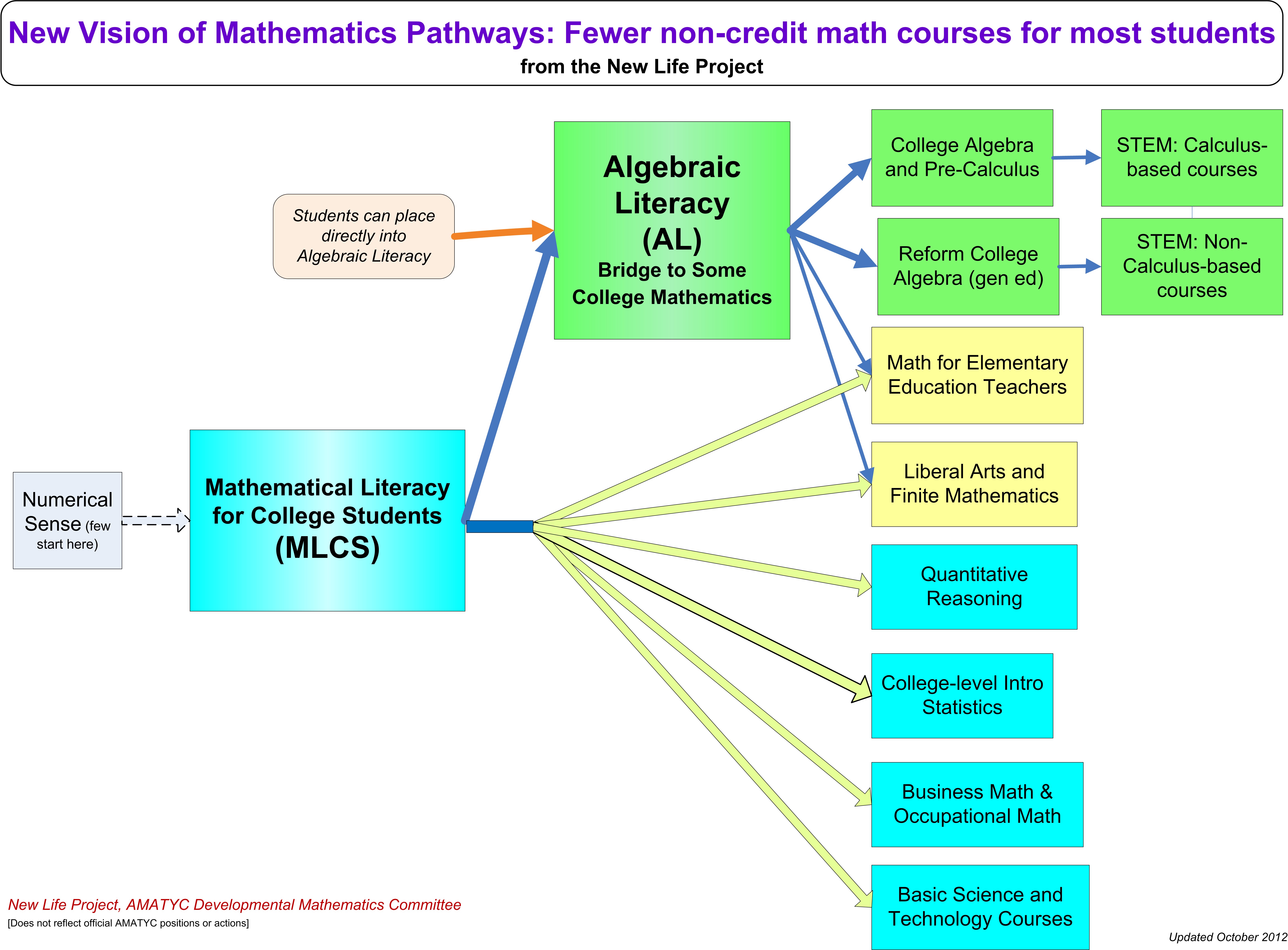
The model has always focused on two developmental math courses to replace the current 3 or 4.  The first New Life course (MLCS) has been well received in the profession as shown by a number of pilots, some books in development, and sessions at the AMATYC conference this year.  However, the second New Life course suffered from a less-clear vision and purpose; in our discussions, we discovered part of this was the name we used … “Transitions” did not communicate much (it was short for “Transitions to College Mathematics”).  After some discussion, we are switching to the new name “Algebraic Literacy” for the second course; this name provides a parallel structure to the first, and suggests that the primary content is algebra (true).  Like any course name, Algebraic Literacy does not tell the entire story; however, we are confident that the new name will work better.

A second problem with that course, the part of the model connecting MLCS with college algebra and courses at that level, is that we did not make it clear that our course would be appropriate for both STEM and non-STEM students.  Our learning outcomes for this course have always included ‘STEM-boosting’ outcomes to indicate preparation for pre-calculus; we are emphasizing that more.  In addition, the visual for the model (below) now shows better connections to college mathematics.

The sequence in our model (MLCS to some college math, MLCS to Algebraic Literacy) originally did not emphasize that students could place directly in to Algebraic Literacy.  This access issue is critical … a basic premise of our work is that we need to create shorter paths; we always intended to have the direct placement option into Algebraic Literacy.  Unfortunately, this was not stated in the visual aid nor stated in most documents about the model.

The other issue we are adjusting for is the need for change in traditional college level mathematics — college algebra in particular.  The Algebraic Literacy course creates the same types of reasoning that a reformed college algebra course would seek to build upon; this is one of the strengths of the New Life model.  The new visual includes a new path specifically for reform college algebra.

Here is the updated visual:


 Join Dev Math Revival on Facebook:

WordPress Themes