Category: Math curriculum in general

Mathematical Literacy: Factoring in the Mathematics Curriculum

Some people will be surprised that our Mathematical Literacy course includes some factoring.  Over the years, the topic of factoring has been a focal point of conversations — almost with the assumption that a reform math course would not cover any factoring.  Sometimes, we go to the extreme view of “anything not practical right now … will be omitted”, and factoring is usually not very practical.

In our Mathematical Literacy course we covered factoring  last week — true, this is just the GCF (no trinomial methods nor special formulas).  Since we only include GCF as a method students have an easier time.  However, if we had time, I would not mind if we covered a little more factoring.

For language skills, it is important that people be able to express thoughts concisely (simplify); in some important situations, it is even more important to be able to express thoughts in a more complex way that maintains the equivalent message — persuasive writing and speaking are particular modes in this style.  In a general way, learning (or a process) that can only be used one direction is usually learned only partially.  Deeper learning depends upon a variety of experiences with objects or ideas.

Factoring plays a comparable role in any course emphasizing algebraic reasoning.  A basic issue in algebraic reasoning is “Adding or multiplying?”  Many of our students believe that parentheses always show two things — what to do first (under the curse of PEMDAS) and “this is a product”.  Our work with the GCF puts students right in the middle of this confusion; in other words, the GCF is a great opportunity for students to better understand basic algebraic notation.

Of course, one risk of this work with the GCF is that students get even more confused.  We need to be careful that assessments help students understand better; within the Math Lit class, I need more experience designing the class work so better assessments can be delivered to students.

Of the traditional developmental algebra content, factoring is not my lowest priority — it connects with basic issues of algebra.  I can’t say the same thing for radical expressions, where we deal with procedures only vaguely connected with exponents.  I also place ‘rational expressions’ lower in priority than factoring; outside of the very basic ideas of reducing simple rational expressions, our time on operations and equations with rational expressions list mostly wasted … the emphasis ends up on procedures, not concepts and understanding. Such topics have been included in developmental courses because they are seen as needed in pre-calculus courses … because they are seen as needed in calculus courses.  We should strengthen this flimsy curriculum design based on student needs AND content needs in deliberate ways.

All of us have a role in this process so that mathematics becomes an enabling process rather than a inhibiting process.  Factoring polynomials is not necessarily an evil to be avoided.

 
Join Dev Math Revival on Facebook:


New Life and Reform at AMATYC 2013

The AMATYC conference (Anaheim, October 31 to November 3) will include several sessions on New Life-inspired efforts to reform developmental mathematics.  I will be doing a general session on the New Life model at the conference, and other sessions will focus on particular implementations.  Over the next month or so, I will be posting a detailed schedule.

This conference will not include a workshop on the New Life courses; this workshop was done at last year’s conference and the materials are still available at http://dm-live.wikispaces.com/workshop2012  If you want to know more about the details of MLCS (Mathematical Literacy for College Students) and AL (Algebraic Literacy), I plan to create some additional 5-minute presentations about each — they will be posted on the “Instant Presentations” page (https://www.devmathrevival.net/?page_id=116)

Some related work will also be available at the conference — the Dana Center “New Mathways Project” will have sessions.  When the mini-program is available, I will post a summary of all reform-related sessions.

 
Join Dev Math Revival on Facebook:


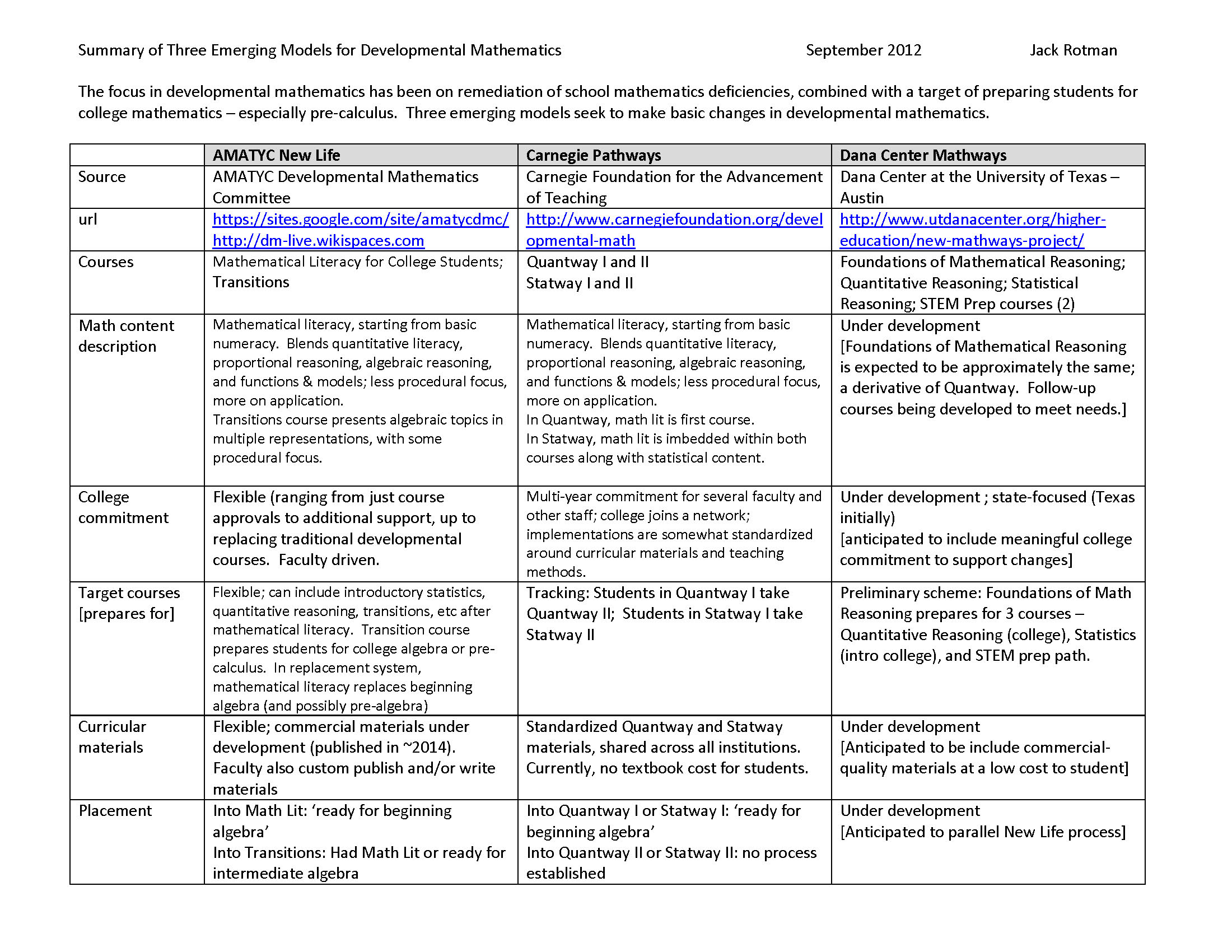
Developmental Math — Summary of Three Models

This is an update to a prior post, with new information … it compares AMATYC New Life, Dana Center Mathways, and Carnegie Foundations Pathways.

ThreeModelsSummaryAoril2013


If you want a download of this file, click on the link below:

Summary of Three Emerging Models for Developmental Mathematics Updated March 22, 2013

Join Dev Math Revival on Facebook:

Hidden Treasure in Math Class

A course design can facilitate learning, and a course design can hinder learning.  I suspect that we get so focused on the details of our math courses that we may not notice whether our course is facilitating or hindering.

In our Math Literacy class, we have been working on algebraic reasoning.  On the surface, the class looks like we are not ‘covering’ very much because we don’t include some typical algebraic (developmental) topics.  We found some hidden treasure this week in class.

As we often do, part of class is based on groups figuring out problems with some guidance and reflection.  Today this meant that we had each group do an equation ‘tag-team’ style — each student could either do the next step, or erase the last step.  Students had a little trouble playing by the rules, and wanted to switch to ‘their’ method to solve the equation.  The payoff came when we talked about the different choices, as more students figured out that they have options for linear equations.

The hidden treasure came next, not that students saw it as totally good.  We looked at how we could solve equations of a type never seen before, starting with a simple rational equation (namely, 5 = 200/x).  Students could see the solution (40) though not always obtained formally, so we talked about doing ‘opposite’ operations to solve.  We followed this with a radical equation (the pendulum model), which is not normally seen in this level of math course.  To solve for the length inside the radical, we listed the calculation steps if we knew the length and wanted to calculate the period.  Then, we reversed — the opposite operations in the reverse order.

To me, the hidden treasure in this is that students get to think about both types of skills that we use in mathematics — we have routine procedures (often based on properties) and we have reasoning about statements (often based on relationships unique to the problem).  Wouldn’t it be wonderful if students developed both strategies, instead of just using routine procedures (often memorized)?

It’s clear that my hidden treasure was not perfectly clear to students; after this discussion, we had a worksheet which included an equation of related design.  They generally understood the reverse order idea, but thought they should do them in a different order — a choice which requires applying properties of expressions.  Our conversation was more satisfying than normal because we had used the reasoning approach, and talked about choices.

Students may still ‘want’ a recipe for solving equations and simplifying expressions.  Giving students a recipe hides the math treasure; emphasizing choices and reasoning allows for the possibility of students finding our hidden treasure.

 Join Dev Math Revival on Facebook:

WordPress Themes