Saving Mathematics, part I

Because ‘developmental mathematics’ has been so much in the spotlight, we tend to treat the remainder of mathematics in the first two years as a stable curriculum with the presumption that it serves needs appropriately.  I suggest that the problems in ‘regular’ college mathematics are more significant than the problems in developmental mathematics.  #STEM_Path #MathProfess

We have indications that pre-calculus is not effective preparation for calculus (see David Bressoud’s note on “The Pitfalls of Precalculus” at http://launchings.blogspot.com/2014/10/the-pitfalls-of-precalculus.html).  The large data set used provides strong evidence for the fallacy of pre-calculus; the history of that course also suggests that it is ill-served for the purpose (see Jeff Suzuki’s talk “College Algebra in the Nineteenth Century” at https://sites.google.com/site/jeffsuzukiproject/presentations) .

The calculus sequence remains unchanged in any fundamental way over the past half-century, in spite of the changing needs of the client disciplines (engineering, biology in particular).  I believe that our calculus sequence is both inefficient and lacking.  In particular, our obsession with symbolic methods and the special tools that accompany them results in students who complete calculus but lack the abilities to do the work expected in their field (outside of mathematics or within).

So, just for fun, think about this unifying view of mathematics in the first two years.

Pre-college mathematics: 2 courses, at most

  • Mathematical Literacy (prerequisite: basic numeracy)
  • Algebraic Literacy (prerequisite: some basic algebra, or Math Literacy course)

College mathematics:  5 courses, at most

  • Reformed Precalculus (one semester only)  (prerequisite: Algebraic Literacy, or intermediate algebra,, or ACT Math 19 or equivalent)
  • Calculus and Modeling I (symbolic and numeric methods of derivatives, integration)
  • Calculus and Modeling II (symbolic and numeric methods of multi-variable calculus)
  • Linear Algebra and Modeling (symbolic and numeric methods, including high-level matrix procedures with technology)
  • Intro to Differential Equations and Modeling (symbolic and numeric methods)

The current curriculum, over the same range, involves 3 to 5 pre-college courses and then from 6 to 9 college courses. The weight of this inefficiency will eventually be our undoing.

By itself, this inefficiency is not strong enough to be a strong risk to mathematics in the short term.  However, our client disciplines are not happy with our work … in many cases, they are teaching the ‘mathematics’ needed for their programs.  In general, those disciplines are focusing on modeling using numeric methods (MatLab, Mathematica, etc); symbolic methods are only used to a limited extent.

Our revised curriculum must be focused on good mathematics, central concepts, theory, and connections … implemented based on sound understanding of learning theory and diverse pedagogy.  The current pre-calculus course(s) offer a good example of what NOT to do — we focus on individual topics, procedures, limited connections, and artificially difficult problems. The capabilities needed for calculus are much more related to a sound conceptual basis along with procedural flexibility.  Take a look at the MAA Calculus Concepts Readiness material (http://www.maa.org/press/periodicals/maa-focus/maa-updates-its-test-for-calculus-readiness) .

We can continue offering the same college mathematics courses that the grandparents of our students took; OR, we can take steps to save mathematics.

 Join Dev Math Revival on Facebook:

Generalities

I have to admit that I am a bit grumpy.  I have to even admit that I was grumpy yesterday in a meeting at my college about developmental education. #Pathways  #MathProfessors

As you may know, I have been in the profession of developmental mathematics for quite a while; in a way, I stumbled upon this work back in 1973, when I was not able to find a high school teaching job … I had spent a year working in a local car dealership doing odd jobs, and managed to get interviewed for an adjunct position at the local community college.

After some time in the work, I discovered that there were both rewards and significant challenges.  I stayed with the job, and eventually connected with AMATYC and our state affiliate; that connection was a key turning point in my life.  All of us involved with mathematics in the first two years of college have a responsibility to our profession and the professional group (AMATYC).

Our work is incredibly important; we make a difference in student lives every day.

So, the grumpiness … essentially, the profession that I have been committed to for over 40 years has been under attack for the past few years.  Reports, foundations, policy makers, and state lawmakers have stepped in to our work; many of declared that developmental mathematics is a failure, and many suggest that students would be better served by being placed directly in to college-level courses with ‘support’.  These attacks, filled with pseudo-data and articulated with propaganda features, seek to preempt the faculty responsibility to maintain the curriculum in colleges.

Generalities … the attacks take some valid criticisms of developmental mathematics, supported by external forces, to create the types of change that certain groups want to see.  Generalities … the challenge of speaking the truth while recognizing the extremes of variation in the work.

At one point in my meeting yesterday, I made some comments about the guided pathways work being started here.  My college has a long history of separation between academics, and between academics and service functions; my ‘generalities’ were meant to suggest that prolonged effort was needed to overcome our decades of certain work climates.

Generalities … when a person does not agree with generalities, the response is often “don’t speak in generalities” (which is what I was told yesterday).  Generalities are the only way to describe a system; this is comparable to having shared definitions in a mathematical system.  Generalities are not the end of the conversation, nor the only factor in decision making; a successful human system requires long-term effort among the community involved.

I am tired of the ‘generalities’ presented as attacks on developmental mathematics.  We know that much needs to be fixed, and I am confident that we (the professionals in the field) can create solutions which will serve our students better.  Some people lob generalities at us in the same way that people lob the “f bomb” in groups; there is an element of bullying involved when outsiders state generalities about how bad our work is.

Rare is the profession where non-professionals are able to implement specific procedures within the profession.

We need a “TEA Party” type movement; perhaps call it “Legislated Enough Already” (LEA) or “Bashed Enough, Dummies” (BED).

Thanks for reading!

 Join Dev Math Revival on Facebook:

Algebraic Literacy: A Bridge to Somewhere (AMATYC 2015)

Here are the materials being used for the session at the AMATYC conference (November 21, 2015).

1. References, and the New Life Project curricular vision
References Bridge to Somewhere AMATYC 2015 final

2. Algebraic Literacy Goals and Learning Outcomes
Algebraic Literacy Goals and Outcomes 2015 cross referenced

3. Sample Lesson: Trigonometry
Algebraic Literacy Sample Lesson Trig Functions Basics 2015

4. Sample Lesson: Rational Exponents
Algebraic Literacy Sample Lesson Rational Exponents 2015

5. Sample Lesson: Rates of Change, Exponential
Algebraic Literacy Sample Lesson Rate of Change Exponential 2015

The sample lessons are licensed under a Creative Commons agreement … ‘by attribute’; the content can be used or modified, with attribution.

 Join Dev Math Revival on Facebook:

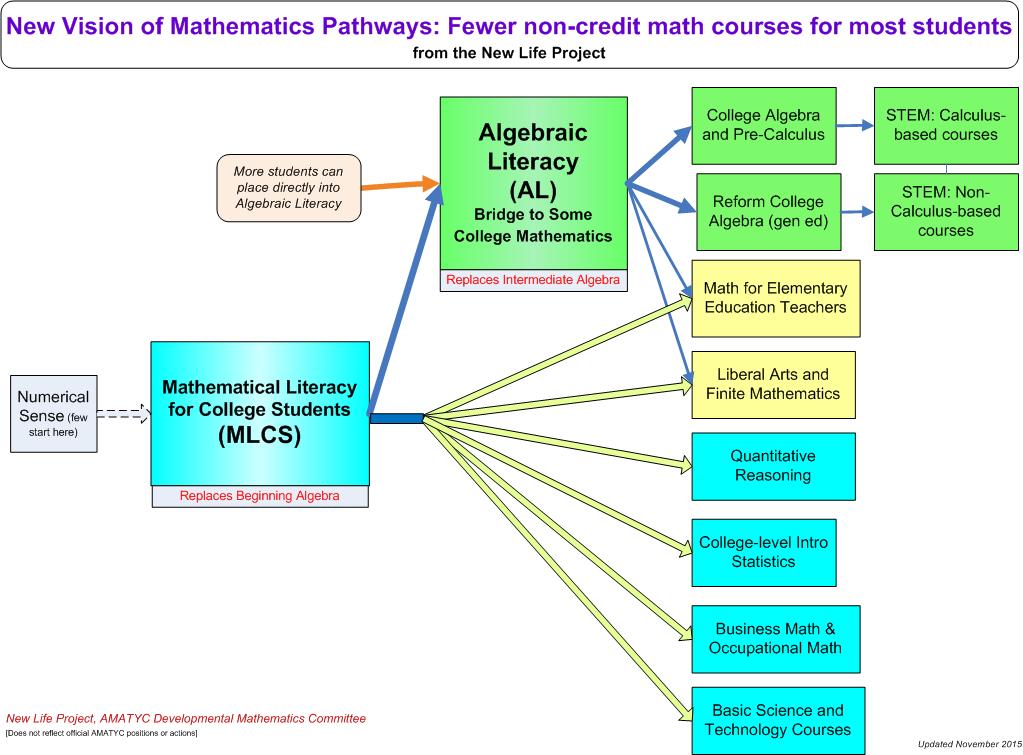
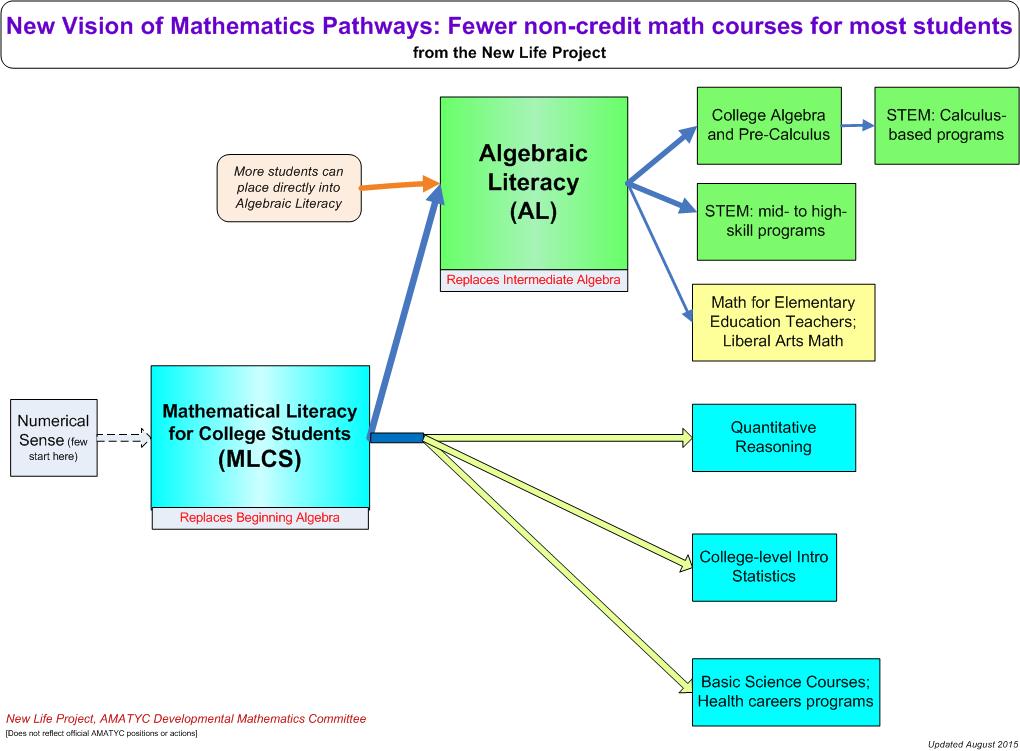
Clarifying the Curricular Vision of the New Life Project

The ‘map’ showing how the New Life Project courses (Math Literacy, Algebraic Literacy) fit into the collegiate mathematics curriculum has been updated.

Here is the version intended for mathematics professionals:
New Math Pathways General Vision 11 18 15


We also have a ‘simplified’ version, intended for those outside of mathematics departments:
New Math Pathways General Vision simplified 11 18 15


These new versions continue the same concepts.  The clarifications involve (A) the eventual use as replacements for the traditional developmental mathematics courses (from 3 or more, down to 2)  and (B) placement into algebraic literacy (more than can go into intermediate algebra).

 Join Dev Math Revival on Facebook:

WordPress Themes