The Case for Remediation

Today, I am at a state-wide conference on developmental education (“MDEC”), where two presenters have addressed the question “is remediation a failure?”.  As you likely know, much of the recent conversation about developmental mathematics is based on a conclusion that the existing system is a failure.  The ‘failure’ or ‘success’ conclusion depends primarily on who is asking — not on the actual data itself.

The “failure” conclusion is presented by a set of change agents (CCA, CCRC, JFF); if you don’t know those acronyms, it’s worth your time to learn them (Complete College America; Community College Research Center; Jobs For the Future).  These conclusions are almost always based on a specific standard:

Of the students placed into developmental mathematics, how many of them take and pass a college-level math course.

In other words, the ‘failure’ conclusion is based on reducing the process of developmental mathematics down to a narrow and binary variable.  One of today’s presenters pointed out that the ‘failure’ conclusion for developmental math is actually a initial-college-course issue — most initial college courses have high failure rates and reduced retention to the next level.

The ‘success’ conclusion is reached by some researchers who employ a more sophisticated analysis.  A particular example of this is Peter Bahr, who has published several studies.  One of these is “Revisiting the Efficacy of Postsecondary Remediation”, which you can see at http://muse.jhu.edu/journals/review_of_higher_education/v033/33.2.bahr.html#b17.

My findings indicate that, with just two systematic exceptions, skill-deficient students who attain college-level English and math skill experience the various academic outcomes at rates that are very similar to those of college-prepared students who attain college-level competency in English and math. Thus, the results of this study demonstrate that postsecondary remediation is highly efficacious with respect to ameliorating both moderate and severe skill deficiencies, and both single and dual skill deficiencies, for those skill-deficient students who proceed successfully through the remedial sequence.  [discussion section of article]

In other words, students who arrive at college needing developmental mathematics achieve similar academic outcomes in completion, compared to those who arrived college-ready.  There is, of course, the problem of getting students through a sequence of developmental courses … and the problems of antiquated content.  Fixing those problems would further improve the results of remediation.

One of the issues we discuss in statistics is “know the author” … who wrote the study, and what was their motivation?  The authors who conclude ‘failure’ (CCA, CCRC, JFF) are either direct change agents or designed to support change; in addition, these authors have seldom included any depth in their analysis of developmental mathematics.  Compare this to the Bahr article cited; Bahr is an academic (sociologist) looking for patterns in data relative to larger issues of theory (equity, access, etc); Bahr did extensive analysis of the curriculum in ‘developmental math’ within the study, prior to producing any conclusions.

Who are you going to believe?

Some of us live in places where our answer does not matter … for now, because other people in power roles have decided who they are going to believe.  We have to trust that the current storms of change will eventually subside and a more reasoned approach can be applied.

In mathematics, we have our own reasons for modernizing the curriculum; sometimes, we can make progress on this goal at the same time as the ‘directed reforms’.  Some of us may have to delay that work, until the current storm fades.

Our work is important; remediation has value.  Look for opportunities to make changes based on professional standards and decisions.

I’ll look for other research with sound designs to share.  If you are aware of any, let me know!


Join Dev Math Revival on Facebook:


Implementing Better Math Courses, Part II: Helping All Students

The traditional developmental math curriculum generally fails the mission to help students succeed in college mathematics; this failure is due to both exponential attrition (too many courses) and to an obsolete curriculum.  In this post, I will describe a specific implementation plan that addresses these problems for ALL students.  #NewLifeMath

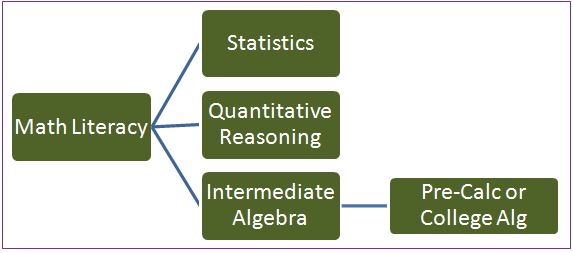
I call this implementation “medium” because it goes beyond the low results of pathways models.  The next level of implementation involves eliminating all courses prior to the beginning algebra level … and replacing beginning algebra with Math Literacy for College Students.

Here is an image of this implementation:
ImplementationMap MEDIUM March2016


This implementation means that the majority of students can have a maximum of one pre-college math course (developmental level), since most students do not need to take a pre-calculus course.  The Math Lit course was designed to serve the needs of all students — STEM and not-STEM; even though many of the initial uses of Math Lit were in pathways implementations, the course is much more powerful than that limited usage.

Doing this medium implementation results in significant benefits to students.  In order to make this work, the institution needs to address interface issues — both prior to Math Lit and after Math Lit.

Math Lit has a limited set of prerequisite knowledge that enables more students to succeed, compared to a beginning algebra course.  However, this set is not trivial.  Institutions doing a medium implementation will need to address remediation ‘prior’ to Math Lit for 20% to 40% of the population in the course.  One methodology to meet this need is to offer boot-camps prior to the semester, or during the first week.  The other method (which my institution is starting this fall) is to embed the remediation within the Math Lit course; in our case, we are creating a second version of Math Lit for 6 credits (with remediation) to run parallel to our 4-credit Math Lit course.

After Math Lit in this model, there is an interface with intermediate algebra.  At some institutions, this will work just fine … because the intermediate algebra course includes sufficient review of basic algebra.  In other institutions, some adjustments in intermediate algebra are needed.  My own institution is playing this safe for now … after Math Lit, students can take a ‘fast track’ algebra course that covers both beginning and intermediate algebra.  I don’t expect our structure to be long-standing, for a variety of reasons (most importantly, that we are likely to reach for the next level of implementation where intermediate algebra is replaced by algebraic literacy).

I suspect a common response to this implementation model is something like “this will not provide enough algebra skills for STEM”.  I would point out two factors that might help deal with this apparent problem:

  1. Taking beginning algebra prior to intermediate algebra is currently associated with lower pass rates (controlling for ACT Math score).  [See https://www.devmathrevival.net/?p=2412]
  2. The basic issue for STEM students is not skills — it is reasoning.  [See AMATYC Beyond Crossroads http://beyondcrossroads.matyc.org/   and the MAA CRAFTY work http://www.maa.org/programs/faculty-and-departments/curriculum-department-guidelines-recommendations/crafty ]

This medium implementation model is conceptually similar to the Dana Center New Mathways Project, where they follow up their adaptation of Math Lit (“FMR”) with their STEM path courses.  Like them, we have confidence based on professional work over a period of decades that this implementation model will succeed.

In a pathways model, only those students who are going to take statistics or quantitative reasoning get the benefits of a modern math course.  In the medium implementation, this set of benefits is provided to ALL students.  In addition, the medium implementation eliminates the penalties of having more than 2 developmental math courses in the curriculum, by dropping all courses prior to Math Lit.  The result is that the majority of students will have 1 (or zero) developmental math course, with improved preparation as well.

 Join Dev Math Revival on Facebook:

National Math Summit — resources, handouts, …

The National Math Summit 2016 was held in mid-March, with over 250 people attending.  We had a very productive 2-day event.

Now, you can access much of the information shared during the “NMS” (national math summit).  Resources and handouts have been posted to a drop-box.

The drop box is https://www.dropbox.com/sh/c3p3lizhfqjjic5/AAARt_ynsNIoeAvuZVOzPn5xa?dl=0

You can share this link, and download the materials from the drop box.  If you have questions about a particular item, contact the primary author.

  Join Dev Math Revival on Facebook:

Why Does Co-Requisite Remediation “Work”?

Our academic leaders and policy makers continue to get strongly worded messages about the great results using co-requisite remediation.  Led by Complete College America (CCA), the originators of such messages suggest that this method avoids the failures of developmental mathematics.   [For example, see http://completecollege.org/spanningthedivide/#remediation-as-a-corequisite-not-a-prerequisite] Those of us in the field need to understand why intelligent people with the best of intentions continue to suggest this uni-directional ‘fix’ for a complex problem.  #CCA #CorequisiteRemediation

I want to focus on the educational component of the situation — not the political or fiscal.  In particular, I want to explore why the co-requisite remediation results have been so encouraging to these influencers.

One of the steps in my process was a nice conversation with Myra Snell.  I’ve known Myra for a while now, and she was involved with the New Life Project as well as the Carnegie Foundation’s Statway work.   What I got from this conversation is that Myra believes that there is a structural cause for the increased ‘throughput’ in the co-requisite models.  “Throughput” refers to the rate at which students complete their college math requirement.  Considerable data exists on the throughput using a traditional developmental math model (pre-algebra, beginning algebra, then intermediate algebra); these rates usually are from 7% to 15% for the larger studies.  In each of the co-requisite systems, the throughput is usually about 60%.  Since the curriculum varies across these implementations, Myra’s conclusion is that the cause is structural … the structures of co-requisite remediation.

The conclusion is logical, although it is difficult to determine if it is reasonable.  Scientific research in education is very rare, and the data used for the remediation results is very simplistic.  However, there can be no question that the target of increased throughput is an appropriate and good target.  In order for me to conclude that the structure is the cause for the increased results, I need to see patterns in the data suggesting that ‘how well’ a method is done relates to the level of results … well done methods should connect to the best results, less well done methods connect with lower results.  A condition of “all results are equal” does not seem reasonable to me.

Given that different approaches to co-requisite remediation, done to varying degrees of quality, produce similar results indicates some different conclusions to me.

  • Introductory statistics might have a very small set of prerequisite skills, perhaps so small a set as to result in ‘no remediation’ being almost equal to co-requisite remediation.
  • Some liberal arts math courses might have properties similar to intro statistics with respect to prerequisite skills.
  • Some co-requisite remediation models involve increased time-on-task in class for the content of the college course; that increased class time might be the salient variable.
  • The prerequisites for college math are likely to have been inappropriate, especially for statistics and liberal arts math/quantitative reasoning.
  • Assessments used for placement are more likely to give false ‘remediation’ signals than they are false ‘college level’ signals.

Three of these points relate to prerequisite issues for the college math courses used in co-requisite remediation.  Briefly stated, I think the co-requisite results are strong indictments of how we have set prerequisites … far too often, a higher-than-necessary prerequisite has been used for inappropriate purposes (such as course transfer or state policy).  In the New Life model, we list one course prior to statistics or quantitative reasoning.  I think it is reasonable to achieve similar results with the MLCS model; if 60% of incoming students place directly in the college course … and 40% into MLCS, the predicted throughput is between 55% and 60%.  [This assumes a 70% pass rate in both courses, which is reasonable in my view.]  That throughput with a prerequisite course compares favorably to the co-requisite results.

The other point in my list (time-on-task) is a structural issue that would make sense:  If we add class time where help is available for the college math course, more students would be able to complete the course.  The states using co-requisite remediation have provided funds to support this extra class time; will they be willing to continue this investment in the long term?  That issue is not a matter of science, but of politics (both state and institution); my view of the history of our work is that extra class time is usually an unstable condition.

Overall, I think the ‘success’ seen with corequisite remediation is due to the very small sets of prerequisite skills present for the courses involved along with the benefits of additional time-on-task.   I  do not think we will see quite the same levels of results for the methods over time; a slide into the 50% to 55% throughput rate seems likely, as the systems become the new normal.

It is my view that we can achieve a stable system with comparable results (throughput) by using Math Literacy as the prerequisite course … without having to fail 40% of the students as is seen in the corequisite systems.

 
Join Dev Math Revival on Facebook:

WordPress Themes