Getting Into Statway or Quantway

In case you missed the webinar on January 24 (by the Carnegie Foundation for the Advancement of Teaching) … institutions can begin a process that may lead to being included in either Statway or Quantway.

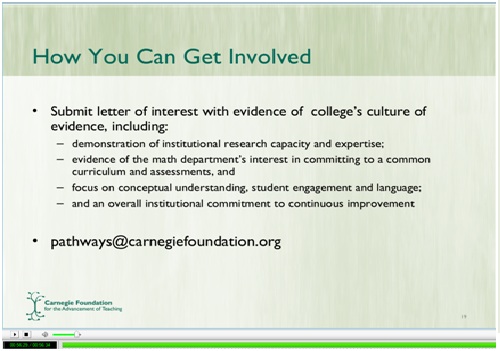
Here is the slide from the webinar dealing with ‘getting into Statway or Quantway’:
Just to review … Statway is a two-semester sequence designed for students who place into beginning algebra, which takes them ‘to and thru’ a college-credit statistics course; statistical topics are the focus of the course, with developmental math topics integrated in both semesters.  
Quantway is a one-semester course designed for students who would take a ‘non-STEM’ course the next semester; it is also designed for students who place into beginning algebra, with a focus on numerical reasoning, proportional reasoning, algebraic reasoning, and functions & models.  After Quantway, students would take a college-credit math course such as quantitative reasoning, statistics, or math for liberal arts.

“Getting into Statway or Quantway” means more than just offering the course; joining a Pathway means being part of the Networked Improvement Community coordinated by the Carnegie Foundation … that is why institutions need to meet the criteria listed above.

If you are ready for this type of change, send your letter of interest to the Carnegie Foundation (email address on the image above).

Join Dev Math Revival on Facebook:

Free Online Materials from NROC?

The National Repository of Online Courses (NROC) has developed extensive materials for developmental mathematics, which are available to preview and pilot test and will be free for individuals to use this fall at HippoCampus.org. Currently, a good beta version of the material is being piloted around the country – with the full release of the material due later this year that will include assessment to individualize a learners’ path through the lessons. Right now, the beta materials for arithmetic and basic algebra are available for previewing – I spent some time looking, and am impressed. Even though the topics look old fashioned, the presentation is very different; the material is engaging and worth learning.

If you would like to get a preview, go NROCmath.org and look under the Higher Ed banner (right side); the materials are called NROC Developmental Math—An Open Program. On that NROCmath.org page, there are links to learn more and to view course now ‘learn more’ provides an overview of the course, and ‘view course now’ provides you access to preview (one unit) the materials. You can register for a password to preview all beta units. (Warning: This will also put you on the mail list to get news of the final release.)

To fully integrate the material into an institution’s curriculum, in-class, blended or online, as a supplement or full course, institutions, systems or agencies may become NROC Network Members and receive technical support, professional development resources and the rights to adapt and import all resources into their own learning management system to adapt and make available to all teachers and students.

Isn’t it great when people share good materials like this?
Join Dev Math Revival on Facebook:

Professional Growth … Connected or Isolated?

Over on the MATHEDCC discussion list, we have been having some difficulties … which essentially are “people declaring a strong point of view, often with negative comments towards others point of view”.

In case you do not know the history of MATHEDCC, here are the basics: A committee in AMATYC (called “Technology in Math Education”, or TiME) created an email discussion list to facilitate conversations among AMATYC members.  The actual list was hosted at various servers, and is currently at the Math Forum.  However, late last year, the AMATYC Executive Board decided to discontinue the official connection between MATHEDCC and AMATYC.

I will not use this post to elaborate on the difficulties seen on the MATHEDCC list.  The purpose of that list, and of this blog, is professional development.  I wonder — can our profession make progress for the sake of our students in the absence of a community for our interaction?  Or, stated another way, does it make any sense for us to work more-or-less individually on improving our teaching and our curriculum?

For me, there is no doubt about the answers to these questions.  If we focus on individual and disconnected progress, the results will be smaller and be at higher risk of not surviving, compared to work by connected professionals.  Shared insights and progress create a change in the profession that is not possible when we are not connected.

Clearly, a discussion list is not the only way for us to be ‘connected’ in a meaningful way; we need to employ a variety of methods to work together (including conferences & blogs).  And, having a discussion list is no guarantee that we will remain connected.  At MATHEDCC, the sense of community is suffering because we do not adhere to a few basic & shared values about our interactions.  Perhaps the email list is not the best asynchronous communication tool at this time; maybe a bulletin board would be better (and there are other methodologies as well).

What do you think?  If you agree that our work needs to be connected among the professionals in our field, do we need a new place to do that (discussion list, bulletin board, etc)?  Are you motivated to help with this work?

Those were serious questions … please provide your answers.  Thanks.

 Join Dev Math Revival on Facebook:

Math – Applications for Living IV

I’ve seen the ads, often on the back of a semi-trailer, where companies say that they will pay so much per mile or so much per mile (and perhaps mention that drivers get to be home on weekends).  I can’t bring mathematics to the weekend issue for drivers, but I can  bring math to their pay system.

A typical rate of fuel consumption for the ‘big rigs’ is 8 miles per gallon (this is a little high, but is nicer for calculation!).   A truck’s speed is supposed to be 60 mi/hr in my state, and the average fuel price is $3.749 per gallon.  How much does fuel cost per hour?

    60 mi/hr * 1 gal/8 mi  * $3.749/gal  = $28.12  (rounded)

I have a problem like this on today’s test in my quantitative reasoning course (only it’s for a car, since not many of my students drive a semi).   If you are curious, a typical car would have  an hourly fuel cost of around $7 … we could get in to the cost per pound per hour, which adjusts for the much larger capacity of the semi for hauling stuff.  However, we can be sure that the average semi is loaded with far more than 4 times what a car carries.

Back to the start of this post … if a company pays semi drivers per hour, the driver has (normally) this fuel cost of roughly $30 per hour.  Now, when I see ads that say “$40 per hour to start”, I know that the real income is closer to $10 per hour.  If the pay is ‘per mile’, the calculation is a little simpler (1 gal/ 8 mi * $3.749/gal, which is something like $0.47 per mile).

Within our class, we are using problems like these to become more flexible in our proportional reasoning — a given rate can be represented in two fractions, with our choice being determined by looking at what we start from and what we need.
Join Dev Math Revival on Facebook:

WordPress Themes