Building a New Developmental Math Curriculum

You may have been wondering whether anybody is ‘making this  real’ when people talk about basic change in developmental mathematics.  Here at Lansing Community College (MI), we have been working on building pathways for students.  Beginning in 2013, we are offering a new course — Math105, Mathematical Literacy based on the MLCS course (New Life).  Math105 will be a prerequisite for 3 of our existing general education math courses.

Connected with this, we planning on a second introductory statistics course which can use this Math105 as a prerequisite.  As a result, students will be able to move from Math105 to one of 4 destination courses — all meeting a degree requirement.  Our beginning algebra course (Math107) will continue to meet the prerequisite for these 4 destination courses, as well as intermediate algebra. 

Here is an image of our math pathways, effective 2013:
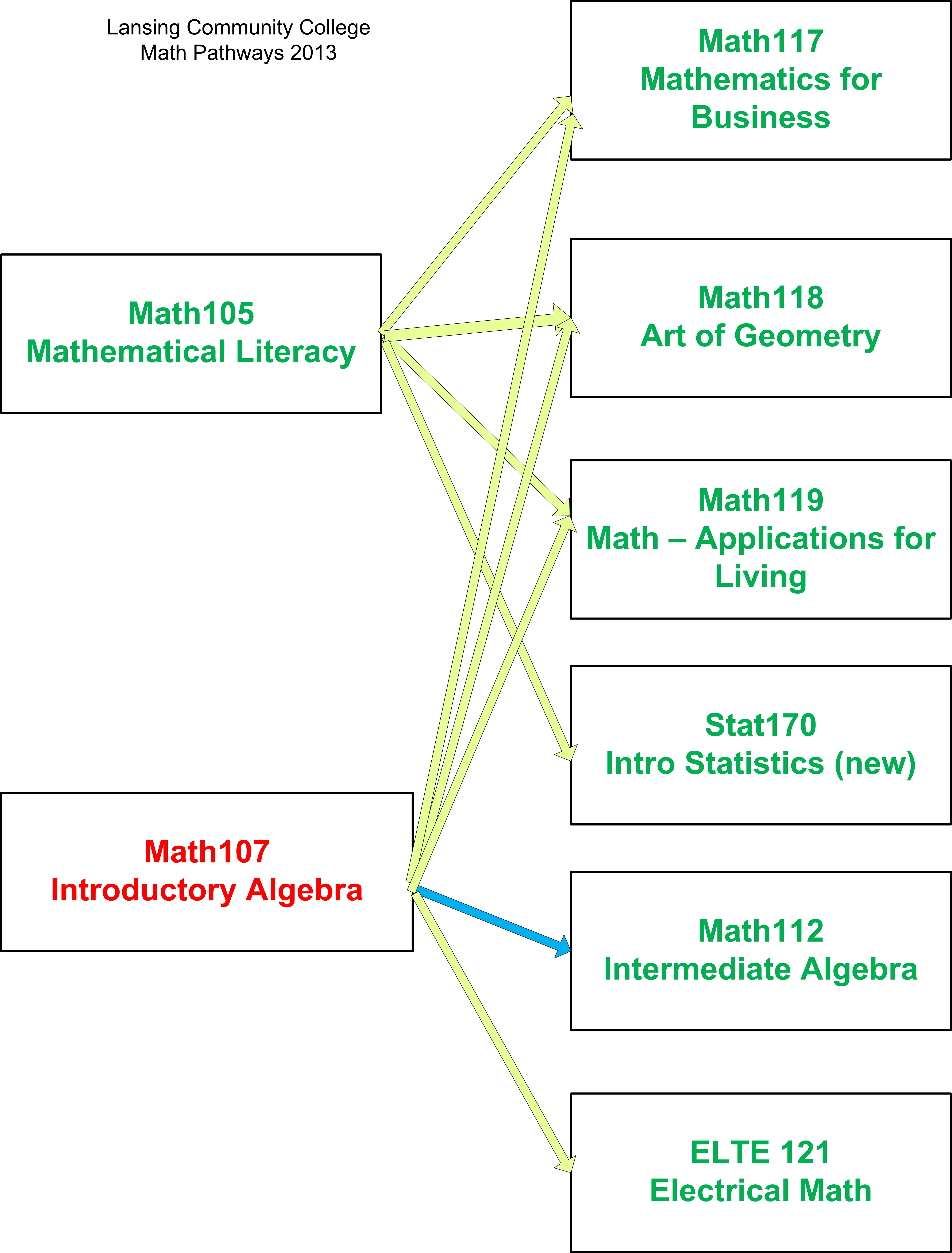
NOTES: The prerequisite to Math105 and Math107 is the same (‘pre-algebra’).  We also have another pathway for ‘Tech Math’ (Math114 and 115), which is stands apart from this image (in general); we make exceptions for some students who change programs after starting Tech Math.

So, here is the main point of this post:  Most of us have math courses that are outside of the beginning algebra to college algebra route, such as business math (Math117 at LCC) or quantitative reasoning (Math119 at LCC) … you can implement a course like MLCS (mathematical literacy for college students) to use as a prerequisite for these other courses.  Some of us are still using arithmetic or pre-algebra as the prerequisite for such courses, and you may find that those prerequisites do not meet the needs very well … and MLCS could be an excellent match. 

We at LCC are enthusiastic about building better math pathways for our students, and we hope you will join us in this work.

 
Join Dev Math Revival on Facebook:

Mathways Webinar – Video available (April 17 webinar)

The Dana Center (University of Texas – Austin) hosted an excellent webinar on April 17.  If you would like to see the video of the webinar, use this link:

https://danacenter.webex.com/danacenter/lsr.php?AT=pb&SP=EC&rID=5109287&rKey=d960ab9030d6c9f9

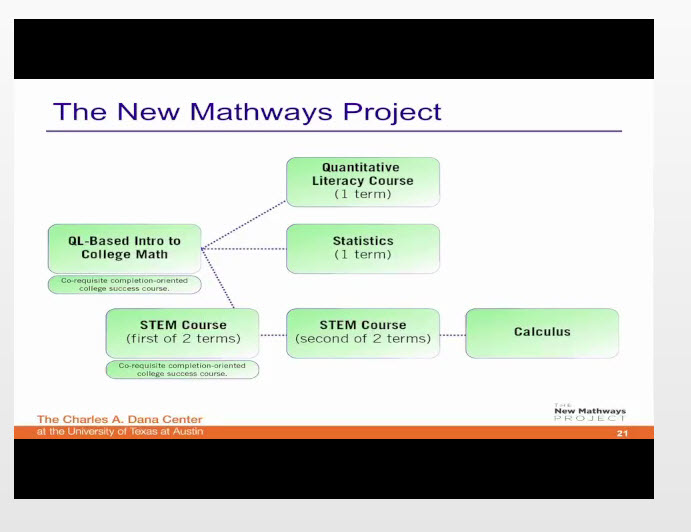
One part of the webinar shows this image of the curriculum structure:


I can see some encouraging similarities between this visual and the New Life model; our work in New Life will be very consistent with the work of the Dana Center.

 
Join Dev Math Revival on Facebook:

Math – Applications for Living IX

In our Math119 course, we are studying models — linear (repeated adding) and exponential (repeated multiplying).  Although some of the details we are including are not very practical, some are practical … and helpful in understanding everyday numbers like ‘inflation’.

Here is a situation we looked at:

If prices increase at a monthly rate of 1.5%, by what percentage do they increase in a year?

Much of our work in class has been on translating from a “percent change” statement to a “multiplying statement”.  Most students saw that this 1.5% increase meant that the multiplier was 1.015.  To answer this question, we just evaluated

We did have a little struggle about using the resulting value (1.1956 …); with a little nudging, we agreed that the annual increase was 19.6%.  Even though we have done quite a few finance applications, this result was a little surprising … students thought we would multiply 0.015 by 12 (18%).

While we were working on models, we also introduced using a calculator procedure to find answers to ‘difficult’ questions [meaning that we used a numeric approach to solving exponential equations].  Take a look at this problem:

Fifty mg of a drug are administered at 2pm, and 20% of the drug is eliminated each hour.  When will it reach 10 mg in the body (the minimum effective level)?

We’ve got that percent change going on; students are generally getting that — this is a multiplier of 0.80.  [This problem is much tougher when I give them drug levels for consecutive 1 hour intervals … like after 3 hours and after 4 hours.].  We set up this equation

To solve this problem, we used a graphing calculator ‘intersect’ process … placing this function on ‘y1’ and the output we needed (10) on ‘y2’.   Our solution (about 7.2 hours)  is useful in understanding the frequency for some prescriptions (3 times per day in this case).  In class, we also approach this same problem as a ‘half-life’ situation; conceptually, that is more complex … and specialized, so we do not emphasize the half-life method.  [Half-life is mostly there to help students if they take a science course which uses half-life concepts.]

We also point out that the intersect process used here is very flexible; it may be one of the most practical things they get out of the course.

 
Join Dev Math Revival on Facebook:

Redesign: The “Basic Skills” Phrase of Today

Let me  say the most important thing first:  Redesign of developmental mathematics is not what is needed; we need to implement new models of meeting the mathematical needs of college students.   Okay, so that is the primary point … here is some background.

You are wondering about this redesign stuff … what does it mean?  How does redesign help students in developmental mathematics courses?  The word itself (“redesign”) has multiple meanings, essentially captured in this definition:

Redesign:  to revise in appearance, function, or content   (from Merriam-Webster dictionary)

A redesign might be referring to just the appearance, like having a 3-color cover for a textbook instead of 2 colors.  Most faculty would be looking for a redesign which looked at function or content (or both), with little concern for appearance.

A redesign is a revision to an existing course or curriculum which results in an altered functioning or content.  I suggest to you that we do not need redesign of developmental math courses; we need something more basic than revision.  Developmental mathematics has not (previously) had a deliberate model for identifying and addressing college student needs for pre-collegiate mathematics.  No, we have not had a model to revise … we have had a history, in fact a long legacy, consisting of loosely connected skills in polynomial arithmetic in service of a mythical calculus preparation.

Beginning a redesign effort assumes (or is based on evidence that) our current system is essentially sound, that it only takes some amount of revision to be good enough.  Think of it with this parable:

In the 1970’s, car companies realized that they would need to produce vehicles with improved fuel efficiency.  Their initial responses were based on the redesign — they took an existing model car, made the body smaller and made the engine as small as possible; with a few cosmetic changes, cars like the Ford Pinto were born.  Although these ‘redesigned’ cars sold reasonably well, the car companies were essentially basing their work on the same designs.  Meanwhile, other car companies (such as Toyota) created cars based on a totally different design — designs in which the better fuel efficiency was just part of a larger vision.  Eventually, the American car companies realized that a new vision of fuel efficient cars was needed … resulting in vehicles that offer a package of benefits including fuel efficiency.

If we redesign our existing developmental mathematics courses, we are putting a GPS unit on a 1973 Ford Pinto.  Now, I’ve got nothing against Ford; it’s a good company, and they have come out with some really nice vehicles.  However, the point is that redesign of developmental mathematics is reinforcing the current vision of the curriculum; this vision is not based on a coherent analysis of student needs and curriculum process … we have historical artifacts which have been given the look & feel of a curriculum.

A redesign of the current courses may provide some temporary relief, just as the ‘small’ cars of the 1970s.  However, we must recognize this basic fact:

We do not have a coherent model of developmental mathematics.

We work hard, we help quite a few students, they work hard … it’s impressive what we have accomplished without a model for our work.  Can you imagine what we are capable of, if we have a model for our work?  Guided and inspired by a vision for a model which meets real students’ needs with solid mathematics, our courses can become places where students realize their dreams and ambitions … where mathematics provides an on-ramp for college success.

So … do NOT redesign.  Get inspired by a new model; take a look at New Life … at Pathways … at Mathways.

 
Join Dev Math Revival on Facebook:

WordPress Themes