What the Experts Say … about Remediation

In our profession (developmental mathematics), the most common phrase this year seems to be “remediation is a failure”; states consider banning all developmental courses, and organizations call remediation a ‘bridge to nowhere’.  What is the validity of these statements?  What is the true status of developmental education in 2012? 

To start with, take a look at a recent article by Hunter Boylan and Alexandros Goudas called “Knee-Jerk Reforms on Remediation”   see      http://www.insidehighered.com/views/2012/06/19/essay-flawed-interpretations-research-remedial-education#ixzz1yG6A5hL2.  Boylan and Goudas review the largest studies that are cited for the ‘failure’ statement, and easily point out the limitations of the research involved.  Some studies employ a discontinuity analysis around the cut score for placement into developmental courses as an estimate of the effects of remediation.  Other studies employ large data sets over a period of time to produce a demographic summary of who is referred to developmental math, who completes developmental, and who completes a college course.  Like other demographic work, these studies can not prove causality.  Neither type of study is a scientific basis for measuring the effect of developmental courses; both are valid estimates to determine the presence of a problem.

Now, I need to address two things … first, why the ‘failure’ message is the default position for so many people inside and outside of the profession; second, what is the true condition of developmental mathematics. 

The failure message is most heard from two sources:  the non-profits advocating for change and a completion agenda, and the foundations funding much of our experimentation.  Neither of these sources is unbiased.  However, sheer repetition from apparently independent sources creates the impression that the failure message is valid.  I think the use of certain metaphors (like ‘bridge to nowhere’) creates an impression of certainty of conclusions, and suggests a cultural acceptance of ‘failure’.  One problem we face is that we have used similar tactics ourselves, as in ‘drill and kill’ and ‘guide on the side’; proof by metaphor …or proof by rhyming … is not scientifically valid.

The true condition of developmental mathematics is much more subtle, which brings with it opportunities and challenges.  A simple ‘failure’ message is easier to interpret and act upon (basically, throw it out!).  The fact is that developmental mathematics delivers some benefits to many students.  The problem is not a total failure of the concept but a lack of an appropriate model to implement the mission and goals.  Developmental mathematics has its roots in remedial mathematics, which was a deliberate repetition of school mathematics; this, in turn, was based on a selective admissions college or university approach.  The vast majority of developmental mathematics is currently carried out in the community college setting, with a diverse population of students; many of these students have an occupational goal … although they may eventually consider a university, their current education is employment based.  Of course, many other students have a university goal.

We have not had a model appropriate for our population of students.  We need to create a deliberate sequence of mathematical experiences to prepare students as quickly as possible for places they will have quantitative needs, whether STEM-bound or not.  Even for STEM students, our existing curriculum is not a deliberate model; the current model presumes that exposure to a topic at a simple level will enable more advanced thinking in a complex setting.  We need a model that emphasizes basic mathematical ideas from the beginning (the ‘good stuff’, as I call it), and let go of making sure that students can produce volumes of correct answers to symbolic questions with fractions and percents … or equations with fractions or radicals.  Mathematical reasoning is far more important than a bag of 100 symbolic tricks and procedures.

The true condition of our profession is that we have become confused by the combination of our own frustrations and these external failure messages.  Ours is a noble calling … if done correctly, developmental mathematics can be part of the process that enables people to be upwardly mobile; instead of the younger generation having a lower standard of living, we can part of the process that creates a better life for the next generation.  Developmental mathematics can also be part of the process of major adjustment for adults who find that their occupation is no longer available.

The true condition of developmental mathematics is an opportunity for the transformative change to sound mathematics to help our students succeed in college and in society (quantitatively).  We face great opportunities; we are not a failure.  We need to look past the external messages to examine our profession with honesty and vision.  Together, we can meet this opportunity with pride and enthusiasm.

 
Join Dev Math Revival on Facebook:

Math Applications … Magic of “Is”

What price are we willing to pay for ‘correct answers’?  What gains (benefits) should students expect for dealing with applications in a math class?

In our beginning algebra class this week, we spent much of our time on applications.  Many of these were the typical puzzle problems involving tickets and cars, integers and angles.  As is normal for this course, students really wanted some magic — a rule that would help them get the correct answer for all of the problems.  Some of the students remembered some magic from a prior math class; one piece of magic was the word ‘is’ … the other piece of magic was a triangle (for mixtures).

We often provide rules (whether perfect or not) that are meant to help students get more correct answers for applications (broadly stated as word problems involving a context).  We tell students that “of” means multiply, and that “is” means equal; the prototype for both rules is the “a is n% of b” template (a worthless model, as normally taught).  Students who have experienced this ‘correct answer’ driven course encounter many problems when faced with a narrative about an application, where ‘of’ is the normal preposition and ‘is’ is the normal verb connecting phrases.  We train our students to surface-process language for the sake of correct answers, and wonder why students continue to have problems with applications.

One of the most challenging problems we did this week was this simply-stated problem:

A store claims that they markup books by 30%, and the selling price for one book is $79.95. Find the cost of the book to the store (before the markup was added).

Every student in this particular class was a graduate of our pre-algebra course, where this same problem was done as part of a longer chapter on percents and applications.  Every student in this class wanted to either multiply by 30% or divide by 30%; a few students thought that there was a second step where they needed to add or subtract this result.

Quite a few of the students could do this problem:

A store sells a book that has a cost of $61.50, and they have a markup on books of 30%. Find the selling price.

Their success on this arithmetic problem was not based on understanding the words any better (the words are the same).  Their success was based on the ‘magic’ rules we had given them that happen to work: multiply by the percent, add or subtract if needed.

The whole point of experiencing applications such as these is to build up the student’s mathematical reasoning.  There might be magic in the world, but magic is not reasoning.  Correct answers based on locally-working magic is worse than wrong answers based on weak reasoning.   If our courses include applications, keep the magic of “is” out of the course … and all other magic. 

 
Join Dev Math Revival on Facebook:

Reform Models in Developmental Mathematics

For many years, our developmental mathematics programs were based on a remedial image — filling in the ‘swiss cheese’ of student’s knowledge of school mathematics, with the school mathematics based on an archaic content (circa 1965).  Now, for the first time, we have an opportunity to explore a model of developmental mathematics that is based on mathematical needs of students — designed especially for community colleges.

During the June 6 (2012) webinar, Uri Treisman presented some general concepts to guide our work in reforming our curriculum; my component of the webinar dealt with applying these concepts in our departments.  In this post, I want to share two possible structures for reform of developmental mathematics as presented that day.  [The recording of the webinar will be available later this summer.]

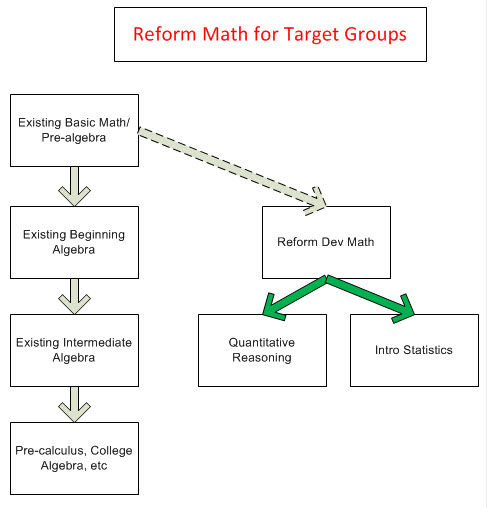
One approach to reform is to target reform for particular groups of students.  You might identify students who need an intro statistics course, or those who need a quantitative reasoning course, and design a prerequisite course just for these students.  In this approach, the existing developmental mathematics curriculum is left undisturbed … at least for now.  The resulting curricular model looks something like this:

This ‘targetted’ approach is reflected in the Statway and Quantway work, for example.  However, this is not the only … nor necessarily best … approach.  Since our content is heavily influenced by archaic high school content, the mathematical needs of students — especially in reasoning and transfer of learning — would be better served by a total reform.

A reform for all students (total reform) has a goal of replacing existing courses.  In this model, the beginning algebra course is replaced by mathematical literacy course (which is also part of the target reform model); the intermediate algebra course is replaced by a reform algebra course … which some students would not have to take to meet their math needs. 

This reform for all students model creates this visual:


The reform algebra course (“B” in this visual) might be the one described as “Transitions” in the New Life model; see http://dm-live.wikispaces.com/TransitionsCourse.  Some colleges might consider a combined beginning & intermediate algebra course for course B; this is not a reform course (as the content is the traditional … and archaic … material).  Another option in this total reform model is to create a faster path in pre-calculus — blend ‘course B’ (reform algebra) and pre-calculus in to a 2 semester sequence for those students. 

Reform in developmental mathematics is needed.  However, reform in developmental mathematics is not sufficient; we also need to reform the introductory college mathematics courses to reflect current needs and professional knowledge.  Our students deserve the best mathematics we can provide, both in developmental and college-level courses.

 
Join Dev Math Revival on Facebook:

Policies that Encourage … Policies that Inhibit … Social Mobility and Equity

Recently, I heard that Ohio is the latest state to officially declare that Intermediate Algebra is the minimum prerequisite to college credit bearing math courses.  The results of such policies are seldom positive for students (and these policies do not help us in mathematics education), and they reflect archaic notions about college mathematics.

I suggest that this ‘intermediate algebra’ policy is a regressive practice which disproportionately impacts students from under-represented groups and those from social groups with lower levels of resources.  Stated another way: These policies prevent community colleges from properly serving specifically those groups for whom community colleges are the institutions of choice.  These groups, collectively seen as “low power social groups”, are critical to both the community college mission and our country’s future.

Most data that I have seen suggests two separate factors that make this policy (and its consequences) so bad:

  1. Low power groups (underrepresented, or low resources) are placed into developmental math at disproportionate rates and at the lower levels of math at disproportionate rates.
  2. Low power groups tend to have even lower rates of success in developmental mathematics (compared to majority/high power groups).

An “intermediate algebra is a gatekeeper” policy reinforces existing inequities in our society, as the students with the fewest options are placed in lower levels of math with more courses to complete but with a lower probability of doing so.

The emerging models (New Life, Carnegie Pathways, Dana Center Mathways) have a basic strategy of creating appropriate mathematics courses for all of our students with a deliberate reduction in the length of the math sequence; instead of 3 or 4 math courses, the new models plan on 2 as a typical sequence.  The “intermediate algebra is gatekeeper” policy conflicts with quicker access to college work, and will limit college completion initiatives; such a policy creates a 72-credit associate degree (counting the required math prerequisites), which means that students using financial aid will ‘run out’ of resources. 

Policy makers are likely to be creating these rules without information on their impact for our students and for the success of our programs.  The AMATYC Developmental Mathematics Committee (https://groups.google.com/forum/?fromgroups#!forum/amatyc-dmc) has a small team currently working on a position statement which might help inform those involved with such policies in the future.

 
Join Dev Math Revival on Facebook:

WordPress Themes